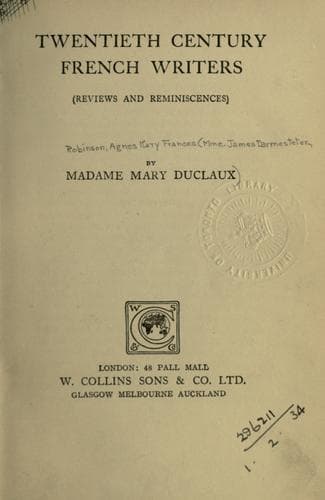
Twentieth Century French Writers: Reviews and Reminiscences — John Shaqi
Twentieth Century French Writers: Reviews and ReminiscencesRobinson, A. Mary F. (Agnes Mary Frances)
History
Twentieth Century French Writers: Reviews and Reminiscences
Robinson, A. Mary F. (Agnes Mary Frances)
French literature -- 20th century -- History and criticism
Every one (every schoolboy, as Macaulay would say) has by heart the
story of _Cyrano_. We all remember the chivalrous hero, with his
hideous nose (_Pif-Luisant_), and his romantic nature; his passion
for the pretty blue-stocking, Roxane; his handsome, stupid friend,
Christian, in whom Roxane thinks she discovers a kindred soul; and
how Cyrano writes Christian’s love letters, using the comely face and
figure of his friend as a mask for his own soul, which thus approaches
the beloved, though under another name; and how Christian, when he
finds that his betrothed really loves, not him, but the mind of the
chivalrous friend whom he has used as a secretary, gets himself killed
in battle, in order that the two persons whom he loves best may be
free to meet and to mate; and we have not forgotten that Roxane is
inconsolable for the handsome Christian; that Cyrano never has the
cruel courage to reveal his passion until, after fifteen years of mute
misery, he dies: is it not written in the chronicles of every theatre
in Europe?
But it is not this pretty, precious, sentimental story which made the
triumph of _Cyrano_; it is the indescribable, incommunicable glory and
gaiety of youth, the ardour, the joy, the fun, the fury, the frolic
which make the piece a perfect Fountain of Jouvence. There is a heroic
cheerfulness in _Cyrano_, a love of life, a generosity, an activity,
a movement, and a flame, which so admirably suit the temper of the
dawning Twentieth Century that we hardly know whether the public made
the play, or the play the public.
Ten years afterwards, Rostand produced his _L’Aiglon_, which was not
greeted with quite the same triumph--the same joy for success, the same
rejoicing for victory. But little by little it, too, won its audience;
and, personally, I prefer this travesty of Hamlet, with all its faults,
to the brilliant, the inimitable _Cyrano_.
For there is a deeper tenderness, a loftier poetry, a more impassioned
patriotism in _L’Aiglon_ than in any other of Rostand’s plays; that
superficiality, that haunting sense of insincerity, which elsewhere
are as the snake in the grass, are scarcely perceptible here. The poor
sick son of the dead hero, the ‘ineffectual angel,’ the sensitive,
inefficient young Duc de Reichstadt, Napoleon’s heir, is drawn with
a feeling and a depth of knowledge which make me suspect that in his
sad protagonist the poet drew, not merely a historical personage, but
his own generation, the children of 1870, the sons of the defeat,
decadent and dilettante, incapable of action, but so touching and so
often noble in their disinterestedness, their sense of the Ideal, their
love of liberty. Rostand, I think, in love and pity has drawn their
portrait--and then drew that of Flambeau to inspire a bolder generation.
Public-domain text, read in full here on John Shaqi.
Reviews
Reviews
No reviews yet
Be the first to share your thoughts on this work.
Join the Discussion
Join the discussion
Sign in to leave a comment or review.
Sign InorCreate an account