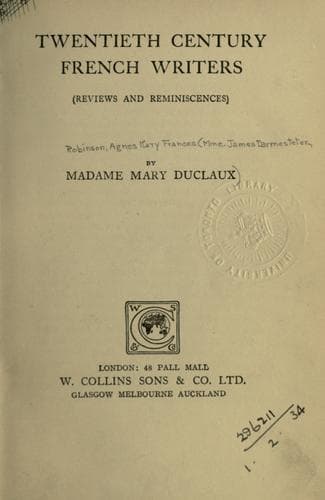
Twentieth Century French Writers: Reviews and ReminiscencesRobinson, A. Mary F. (Agnes Mary Frances)
History
Twentieth Century French Writers: Reviews and Reminiscences
Robinson, A. Mary F. (Agnes Mary Frances)
French literature -- 20th century -- History and criticism
It is a commonplace to say that the Twentieth Century is an age of
deeds, not words, that the young generation (in France especially) are
born not dreamers, but doers. Claudel himself is a traveller and a
man of action. A native of Picardy (he was born in 1868 of a Vosgian
stock,) he has lived of late years little in Paris and in the world of
letters. A pupil of the Symbolists, Arthur Rimbaud and Mallarmé, he
left France for America in his early youth, at four-and-twenty years of
age, to make his way in the Consular service. It would be interesting
to learn in what degree this aristocrat (by temperament at least), this
Catholic, suffered the contact of the democratic prophet, Walt Whitman.
There are points of similarity, not only in the form. A few years later
we find him Consul at Tien-Tsin (one of the finest of his odes is dated
from Pekin), and since then, Paul Claudel has become an authority and
a specialist in the Chinese affairs of the French Foreign Office. In
1908 he returned to Europe in order to assume the duties of Consul at
Prague, then at Frankfort-on-the-Main, and, at the present moment, he
is Consul-General at Rio-Janeiro.
The poet, therefore, is no idle singer of an empty day; and his
heroes, too, are men of action--a general in _Tête d’Or_; a hydraulic
engineer in _La Jeune Fille Violaine_; an American merchant in
_L’Échange_; a Consul in _Partage de Midi_; a political agitator in
_L’Otage_; an architect in _L’Annonce Faite à Marie_. And the sense
of his plays, if we read them right, is that not poetic feeling, but
effort, should be our daily bread; that mere sentiment is sterile
and incoherent (the adventurous Louis Laine in _L’Échange_ is the
slave of the sentiment of the hour); that activity, even when it is
evil activity, may bring forth a better future (the murderous Mara
in _L’Annonce_, the brutal Toussaint in _L’Otage_ are, no less, the
begetters of to-morrow); but that while energy should inspire our life,
yet none the less there is something infinitely better which comes not
by taking pains, something better than all our work and labour, just as
there is something infinitely better than Life, which may descend upon
us, uplift us, carry us into a superior sphere: there is the Grace of
God, there is Inspiration, there is ‘La Muse qui est la Grâce!’
For, at heart, this poet of airmen and soldiers is a sort of lay monk,
reserving his palm of praise, not for the conqueror, but for the rapt
ecstatic--the solitary, dying with half his labours unachieved, the
hermit Violaine, the broken-hearted wife of Toussaint Turelure. And we
might inscribe all his books, for an epigraph, with that line of the
Vulgate, which Renan wrote in the monks’ ledger at Monte Cassino: ‘Unum
est necessarium ... et Maria elegit optimam partem.’
Public-domain text, read in full here on John Shaqi.
Reviews
Reviews
No reviews yet
Be the first to share your thoughts on this work.
Join the Discussion
Join the discussion
Sign in to leave a comment or review.
Sign InorCreate an account