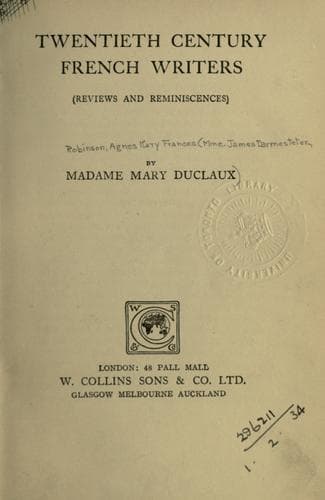
Twentieth Century French Writers: Reviews and ReminiscencesRobinson, A. Mary F. (Agnes Mary Frances)
History
Twentieth Century French Writers: Reviews and Reminiscences
Robinson, A. Mary F. (Agnes Mary Frances)
French literature -- 20th century -- History and criticism
From these plays--romantic, disconcerting, oversubtle--emerge (as
Meredith’s women, wonderfully human, break through the tinsel veil of
his artificialities) the most living and the most lovable of heroines.
The Marthe of _L’Échange_ may be a symbol, may mean the Church, as we
have been told, or (as the poet himself has recently informed us) may
incarnate one state of his own soul; she is certainly the most adorable
of Frenchwomen--French and woman to the tips of her fingers, prudent
and pure, silent and sage, wife-like and wise, full of well-planned
economies and exquisite order:--a type our poet is never weary of
reproducing.
The heroine of _L’Otage_ might be her sister; the long, slim, silent,
energetic girl, who is all conscience and courage, lifted just one
degree higher; no heroine, no virgin merely, but a saint, stretched
on the Cross to the extreme of human greatness. The one exception in
M. Claudel’s gallery is the extraordinarily living portrait of an
Englishwoman, or Irishwoman, in _Partage de Midi_: Ysé, with her fresh
beauty and her yellow hair--Ysé, who is just woman, as Eve was woman;
all passion, instinct, sex, all beauty, flower and grace: Ysé, whom we
associate mysteriously with the Epode of _La Muse qui est la Grâce_,
when the poet, overcome by memory, cries to the Grace of God:--
‘Va-t-en! Je me retourne désespérément vers la terre!
Va-t-en! Tu ne m’ôteras pas ce froid goût de la terre.
Cette obstination avec la terre qu’il y a dans la moelle de mes os
et dans le caillou de ma substance, et dans le noir noyau de mes
viscères!
* * * * *
‘Qui a crié? J’entends un cri dans la nuit profonde!
J’entends mon antique sœur des ténèbres qui remonte une autre fois
vers moi, L’épouse nocturne qui revient une autre fois vers moi,
sans mot dire,
Une autre fois vers moi, avec son cœur, comme un repas qu’on se
partage dans les ténèbres,
Son cœur, comme un pain de douleur, et comme un vase plein
de larmes.’
It is extraordinary that this great prose-poet, who is known at least
to an _élite_ in Italy, who, in the course of the year 1913, has been
acted with success in Germany, at Strasburg, at Frankfort, and at
Dresden; whose plays, in 1914, have twice excited enthusiasm on the
Parisian stage, should have no public in our islands. Is there no
translator brave enough to undertake _L’Otage_, the most accessible
of Claudel’s plays, or _L’Annonce_, so like the poems of our own
pre-Raphaelites? The readers who enjoy Thomas Hardy’s _Dynasts_, or
Doughty’s plays of Britain, should not find them impossibly difficult,
they might even welcome the fresh source of a singularly noble pleasure.
Public-domain text, read in full here on John Shaqi.
Reviews
Reviews
No reviews yet
Be the first to share your thoughts on this work.
Join the Discussion
Join the discussion
Sign in to leave a comment or review.
Sign InorCreate an account