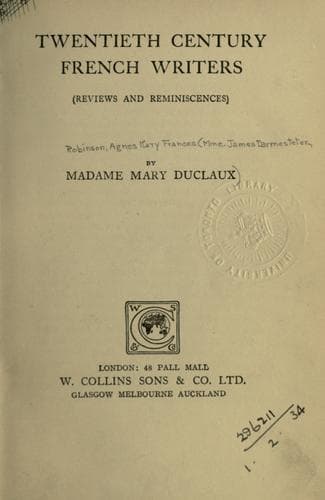
Twentieth Century French Writers: Reviews and ReminiscencesRobinson, A. Mary F. (Agnes Mary Frances)
History
Twentieth Century French Writers: Reviews and Reminiscences
Robinson, A. Mary F. (Agnes Mary Frances)
French literature -- 20th century -- History and criticism
But this conversion has not greatly changed the nature of the poet.
His verse is still fresh with the fragrance of wild thyme newly wet
with dew. He continues to sing his happy valley, with the mountain
towering up behind, right into the blueness of the sky. Only, in his
landscape, he gives more prominence to the village church, garlanded
with yellow roses: _L’Église habillée de Feuilles_.
‘Par cette grande paix que l’homme cherche en soi;
Par les jours finissants aux vieux balcons de bois
Où le cœur noir des géraniums blancs s’attriste;
Par l’obscure douceur des choses villageoises;
Par les pigeons couleur d’arc-en-ciel et d’ardoise;
Par le chien dont la tête humble nous invite
À lui passer la main dessus; par tout cela:
Chapelle, sois bénie à l’ombre de ton bois!’
His verse has still its candour, its ingenuous freshness, its
Franciscan simplicity:--
‘Je prendrai mon bâton et sur la grande route
J’irai, et je dirai aux ânes, nos amis:
Je suis Francis Jammes et je vais au Paradis.
Car il n’y a pas d’enfer au pays du Bon Dieu.’
And yet so great a change has necessarily had its repercussion in
the very form of the poet’s art: Francis Jammes is no longer a
_ver-librist_. Having accepted a discipline for his soul, he may well
admit one for his muse. He would no longer write:--
‘J’avais été assez éprouvé pour connaître
Le bonheur de finir ses jours dans la retraite;’
and think he had done his duty by the rhyme. He would not now content
himself with the loose and lazy assonance of a verse (a beautiful
verse) like the following:--
‘Accablé, je m’étais assis, tant les ajoncs
Étaient impénétrables.
Quand j’eus équilibré mon fusil contre un arbre,
Je relevai le front.’
His last charming volume of Bucolics, _Les Géorgiques Chrétiennes_, is
written in rhymed Alexandrines, which differ only from those of classic
French poetry in a few innocent and agreeable liberties--a plural and a
singular being allowed to rhyme together, the mute E not counting where
it is not pronounced. It is a pleasant form of verse. The picture of
the harvesting angels whirling in the sky, which opens the poem, has
the rich colour and the large facility of a fresco by Correggio--say,
the Assumption at Parma. It is beautiful with a calm beauty:--
‘De temps en temps l’un de ces anges touchaient terre
Et buvait à la cruche une gorgée d’eau claire.
‘Sa joue était pareille à la rouge moitié
De la pomme qui est l’honneur de compotier.
‘Il reprenait son vol, et d’abord sa faucille.
Quelque autre alors foulait l’ombre qui fait des grilles.
‘Ou tous ils descendaient ensemble, ou bien encor
Ensemble reprenaient avec calme l’essor.
‘Chacun avait passé le bras à sa corbeille
Dont les tresses formaient comme un essaim d’abeilles.
Public-domain text, read in full here on John Shaqi.
Reviews
Reviews
No reviews yet
Be the first to share your thoughts on this work.
Elsewhere in the archive
Join the Discussion
Join the discussion
Sign in to leave a comment or review.
Sign InorCreate an account