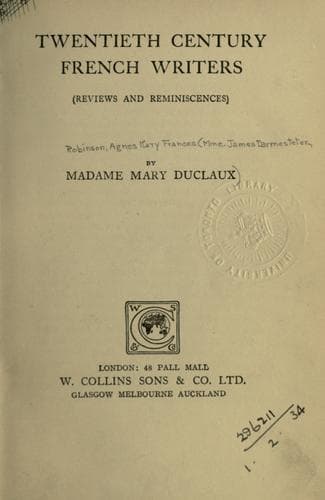
Twentieth Century French Writers: Reviews and ReminiscencesRobinson, A. Mary F. (Agnes Mary Frances)
History
Twentieth Century French Writers: Reviews and Reminiscences
Robinson, A. Mary F. (Agnes Mary Frances)
French literature -- 20th century -- History and criticism
But Alissa was not a saint. She was an artist in Mysticism, a refined
and fastidious spirit ‘who would give all Hugo for a few sonnets by
Baudelaire.’ Nothing in her life shows that warmth, that zeal, that
desire to rush in and save which marks the saint, however visionary,
however ecstatic, be she Saint Teresa or St Catherine, be he St
Francis of Assisi or St Francis of Sales. In place of that simple and
passionate impulse of the soul Alissa, in her self-regarding solitude,
is all scruple, all a fastidious fear of doing wrong. We think of her,
and, opening Fénelon’s _Spiritual Letters_, we read:--
‘Rien n’est si contraire à la simplicité que le scrupule. Il cache
je ne sais quoi de double et de faux; on croit n’être en peine
que par délicatesse d’amour pour Dieu; mais dans le fond on est
inquiet pour soi, et on est jaloux pour sa propre perfection, par
un attachment naturel à soi....’
Over against these strenuous, self-torturing spirits, who arrive with
difficulty at perfection, thanks to ‘une certaine force et une certaine
grandeur de sentiment,’ the great Archbishop sets the luminous peace of
those quiet souls who glide, as it were, into their true haven, without
a conscious effort.
‘Tout les surmonte, selon leur sentiment; et elles surmontent tout,
par un je ne sais quoi qui est en elles, sans qu’elles le sachent.
Elles ne pensent point à bien souffrir; mais insensiblement chaque
croix se trouve portée jusqu’au bout dans une paix simple et
amère, où elles n’ont voulu que ce que Dieu vouloit. Il n’y a rien
d’éclatant, rien de fort, de distinct aux yeux d’autrui, et encore
moins aux yeux de la personne. Si vous lui disiez qu’elle a bien
souffert, elle ne le comprendroit pas.’
We read and reflect that such a friend as this was just what was
lacking to Alissa Bucolin. She would doubtless have been happier as
a Roman Catholic (only even then she might have chanced on a Pascal,
who would have exasperated her qualities, instead of on a Fénelon,
who would have tempered and allayed them to a milder perfection). A
spiritual director would have turned her energies into courses of work
and prayer, would have drawn her mind from the attraction of the abyss,
would, perhaps, have married her (like Juliette) or, more happily, have
fulfilled her vocation in some great active religious order, where an
Alissa may succour and inspire a multitude of lesser natures. Or, had
the bent to contemplation proved too strong, he would have let her
enter the contemplative life, but not alone. A soul, scarred by what
Sainte-Beuve has described as _la griffe de l’archange_, may be seized
with a vertigo, on attaining the summits of the inner world, if on
these giddy heights no staying, guiding, protecting hand be near. _Vae
soli!_
Public-domain text, read in full here on John Shaqi.
Reviews
Reviews
No reviews yet
Be the first to share your thoughts on this work.
Elsewhere in the archive
Join the Discussion
Join the discussion
Sign in to leave a comment or review.
Sign InorCreate an account