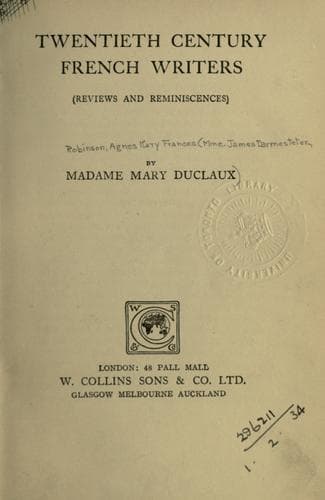
Twentieth Century French Writers: Reviews and ReminiscencesRobinson, A. Mary F. (Agnes Mary Frances)
History
Twentieth Century French Writers: Reviews and Reminiscences
Robinson, A. Mary F. (Agnes Mary Frances)
French literature -- 20th century -- History and criticism
How I regret that during those eighteen months which the young
soldier spent at Versailles, in order to obtain his brevet of
second-lieutenant, I remained unaware of his presence in France! Péguy
has left an eloquent description of his friend and young alumnus,
telling how he lived like a king in the palace of the École Militaire,
but a step from the dome of the Invalides whither in the summer
mornings, in the freshness of the dawn, he used to escort his slender
little three-inch cannon--‘ses 75, ces petits jeunes gens de canons
modernes, ces gringalets de canons modernes, au corps d’insecte, aux
roues comme des pattes d’araignées’--filing them off under the shadow
of the monstrous historic artillery of the great Pensioners’ Hospital,
the cannon of Fontenoy and Malplaquet, bronze mastodons and leviathans
of an earlier age. I can imagine Ernest, ‘l’homme au regard pur’ (as
Péguy calls him); I can see him, a young Hippolytus of the School of
War, in my mind’s eye--but I did not see him in the world of facts.
Before I learned of his presence in my neighbourhood he had left--he
and his battery--for the deserts of Mauritania, and there, in the
desolate tropical country that lies between the burning plains of
Senegal and the sands of the Sahara, he spent three happy years. He
sent home a little book--_Terres de soleil et de sommeil_--which marked
the awakening of his literary gift; but the real event of those three
years, for Ernest, was his ardent conversion to the Catholic Church.
Ernest was a mystic; the only life possible to his insatiable heart
was the spiritual life; and in the Sacraments he sought that assurance
of a world beyond our own, in constant communication with our own,
which other minds may find by other means. His fervour, his faith, was
henceforth a remedy for all his sins and all his sorrows; and, young as
he was, he had had his sorrows--doubtless, also, his sins.
It was, I think, in the end of 1912 that Ernest left that immense
and mortal splendour of the Sahara and came back to France, bringing
with him a short military novel, _L’Appel des Armes_, which (coming
after Péguy’s elaborate pæan) received, on its publication in 1913,
an honourable, a more than honourable, welcome.... I was one of the
welcomers. Few things are pleasanter to the hoary critic than the
_éclosion_ of a fresh young talent, and naturally all the more when
that talent flowers on a dear familiar stem. On this occasion I renewed
my long-interrupted friendship with the young author, and we promised
ourselves a more frequent communication of our ideas. Fate however,
decided otherwise. Ernest and his battery were sent to the cliffs of
Cherbourg. And, a year later the great war began....
Public-domain text, read in full here on John Shaqi.
Reviews
Reviews
No reviews yet
Be the first to share your thoughts on this work.
Elsewhere in the archive
Join the Discussion
Join the discussion
Sign in to leave a comment or review.
Sign InorCreate an account