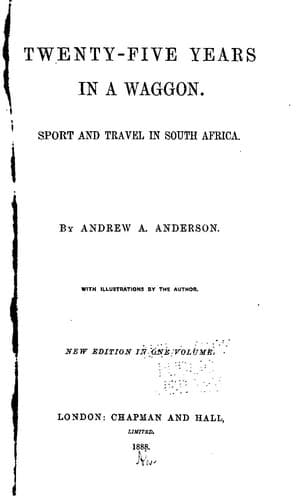
Twenty-Five Years in a Waggon in South Africa: Sport and Travel in South AfricaAnderson, Andrew A.
History
Twenty-Five Years in a Waggon in South Africa: Sport and Travel in South Africa
Anderson, Andrew A.
Africa, Southern -- Description and travel; Anderson, Andrew A. -- Travel -- Africa, Southern
crocodile as he seemed asleep on the bank. He measured eleven feet.
Being only a short distance from the Limpopo river, which is broad and
in places very deep, these reptiles seem to swarm; and its well-wooded
banks give shelter to hundreds of monkeys, and also to many beautiful
birds.
At the junction of the Notuane river with the Limpopo, the altitude is
2880 feet at the drift, which is one of the main roads from Pretoria in
the Transvaal to the trading-station Mongwato, and the chief Khama's
capital; the distance by road from the drift is seventy-three miles.
The territory of Sechele, which also includes those portions now claimed
by the petty chiefs Linsey at Motsodie, and Maklapan at Chene Chene, are
valuable and well-wooded districts, with many native kraals; the people
cultivate the land, use ploughs, and grow corn which supplies largely
the inhabitants on the border of the Transvaal, and is taken in exchange
for English goods through traders from the Cape Colony, and they also
rear large herds of cattle. If a settled form of government is
established, and Boer invasions put down, the country will soon become
highly valuable as a market for British merchandise, as the natives are
very industrious, and quite alive to the importance of trade; most of
the beautiful karosses that find such a ready sale in the home markets
are made by the Bechuana people. In all these chiefs' territories they
are excellent mechanics, manufacturing tools and utensils from native
iron, and good forges are now being introduced. They have hitherto used
for heating their metal, air-bags, connected by a tube, one placed under
each arm, which they press to their side, which causes a blast
sufficient to melt or heat the metal, which they hammer into form with
stones. But this primitive mode is going out of use, and the ordinary
bellows is being adopted. They purchase extensively of colonial
traders, iron pots, kettles, saucepans, and tin utensils, as also every
kind of wearing apparel, and if the country is protected from Boer
marauders, the British merchant may look forward at no distant date to
an extension of trade in these regions, over and above the present
sales, up to several millions annually, as the great stride towards
civilisation during my time has been most satisfactory. Twenty years
ago, where one trader's waggon went in, in 1880 there were fifty, which
was stopped on the retrocession of the Transvaal to the Boers, when a
collapse took place, and has continued through the murderous attacks and
robbery of the Boers on the natives, but which, I trust, will now be put
an end to by the British Government proclaiming a protectorate over all
this extensive and valuable region.
CHAPTER TEN.
THE CHIEF KHAMA'S TERRITORY OF THE BAKALIHARI TRIBE OF THE BECHUANA
FAMILY.
Public-domain text, read in full here on John Shaqi.
Reviews
Reviews
No reviews yet
Be the first to share your thoughts on this work.
Elsewhere in the archive
Join the Discussion
Join the discussion
Sign in to leave a comment or review.
Sign InorCreate an account