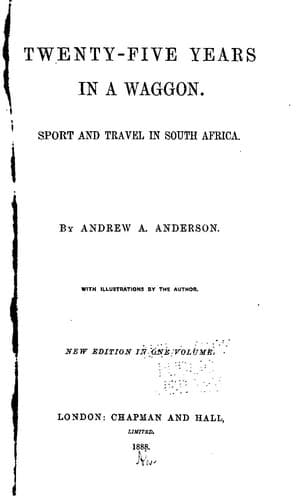
Twenty-Five Years in a Waggon in South Africa: Sport and Travel in South AfricaAnderson, Andrew A.
History
Twenty-Five Years in a Waggon in South Africa: Sport and Travel in South Africa
Anderson, Andrew A.
Africa, Southern -- Description and travel; Anderson, Andrew A. -- Travel -- Africa, Southern
been preserved from animals defacing them. In several parts of the
country many of them are well executed.
A few days previous to my arrival here in 1877, three Boers, with their
waggons, were endeavouring to find a new drift in the Limpopo river, and
went in to cross to the opposite side. They had nearly reached the
bank, when the foremost looked round and saw a large crocodile come up
from the water and seize the head of the last man between his jaws, and
disappear with him. His name was Herman, a married man, twenty-six
years of age. Nothing more was seen of him but blood in the water. His
widow, a few months after, consoled herself with another husband. At
this time, soon after the British Government had annexed the Transvaal,
the Boers, wherever I met them, were always friendly--so much so, that I
have often been invited to take one of their daughters for a wife. They
were rather proud to have an Englishman for a son-in-law. I was
outspanned not many weeks back at a very pretty pool of water, or
spring, the water of which fell into the Notuane river, in what is
termed the Bush Veldt, that I might have a little shooting. The second
day an old Boer and his wife came to me to ask if I would buy some
ostrich feathers, taking me to be a trader, for all Englishmen
travelling through the country will do a little in the way of barter;
therefore I told them if they were good I would. When coffee was handed
to them as a matter of custom, they asked where my wife was. On stating
I was single, the old vrow said I must have one of her daughters; she
had two mooi (pretty) girls, and would bring them the next day for me to
see when she brought the feathers. Accordingly, the next day, true to
her promise, she came with the old man and her two girls to the waggon;
both very young, the eldest not more than seventeen, and not bad-looking
for Dutch girls, apparently very modest and shy, with a conscious look
of what they were brought for. After settling about the feathers, the
old mother pointed out her daughters to me, and told me, pointing to the
eldest, she would make me a mooi vrow, and that she had a farm of her
own and some stock. Both the girls, sitting together by their mother,
looked down and giggled every now and again, giving me sly glances from
beneath their cappies (the usual covering for the head for old and
young), and then another giggle. They had evidently been got up for the
occasion by their smart dresses, well-made English boots, and clean
white stockings, to show off a pretty foot and ankle, which certainly
they both possessed, and were not backward in showing. This is very
unusual, they generally have clumsy feet. When at home these articles
are never worn, only leather shoes called veldtscoons, which the men
make. They say--which is quite true--that stockings are dirty when you
walk about in a sandy country. However, after a long visit, coffee and
biscuits, I arranged that on my return I would come and pay them a
Public-domain text, read in full here on John Shaqi.
Reviews
Reviews
No reviews yet
Be the first to share your thoughts on this work.
Elsewhere in the archive
Join the Discussion
Join the discussion
Sign in to leave a comment or review.
Sign InorCreate an account