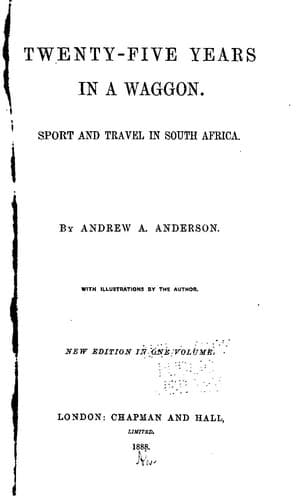
Twenty-Five Years in a Waggon in South Africa: Sport and Travel in South AfricaAnderson, Andrew A.
History
Twenty-Five Years in a Waggon in South Africa: Sport and Travel in South Africa
Anderson, Andrew A.
Africa, Southern -- Description and travel; Anderson, Andrew A. -- Travel -- Africa, Southern
The sickly season is from September to May. Many parts are open, with
little bush; another part of the desert is thick bush, and very scarce
of water in the dry season, and is a part of what is called thirst-land
(thirst) from the dryness of the country, and where the trek Boers
suffered so much in their journey to the westward in 1877. In that year
I was at Mongwato, and came in for my share a few months later, when
there in October of that year. Mr. Harry Shelton, who had a large store
at Leshulatebes station, Lake N'gami, was coming to Mongwato with
several of his waggons for goods, and two saddle-horses he had with him,
having treked 150 miles along the road which skirts the river Zouga; he
was obliged to leave his waggons and oxen, as no water would be found
between that place and Mongwato, a distance of 160 miles, and came on
with his two horses, but on the road was obliged to leave one of them
from exhaustion, and managed to come in with the other, and was obliged
to be lifted from the saddle on his arrival, having been nearly four
days without water. On his return fourteen days after, he expected, of
course, to see the horse dead and eaten by lions; but he found him
standing by the same bush he was left at, and he recovered. This shows
how long a horse may live under such circumstances. Horses, however,
knock up far sooner than oxen from thirst. The lions and wolves must
have forsaken the country as well as the game, otherwise the horse would
have been eaten. Most of his oxen had died on his return, principally
from licking the moist mud in the pans and river. When so many days
without water they cannot drink when brought to it. The only means then
of preserving their lives is to throw buckets of water over them; but
this does not always succeed. Such are the trials and hardships we have
to put up with in a region so liable to long seasons of drought, and
where the country is so destitute of springs or standing water. But
with all these drawbacks there is a fascination that impels one on to
explore these remote and little-known regions. The bright and clear
atmosphere, the lovely mornings and evenings for travelling, the
constant change of scene, the splendid tints of the sunsets, and variety
of foliage of the vegetation, the calmness of everything around, and the
constant excitement of strange game to be seen, is a pleasure we can
seldom enjoy, and, as I have before stated, the only true enjoyment in
Africa is waggon travelling in the interior, where time is not limited.
The watershed dividing the Zambese and the Limpopo basins runs to the
east of the great Makarakara pans, in a north-east direction through the
Mashona and Matabele country, and from the south-west to the Kalahara
desert near Kaikai Pits, the elevation being 4260 feet above sea-level.
Public-domain text, read in full here on John Shaqi.
Reviews
Reviews
No reviews yet
Be the first to share your thoughts on this work.
Elsewhere in the archive
Join the Discussion
Join the discussion
Sign in to leave a comment or review.
Sign InorCreate an account