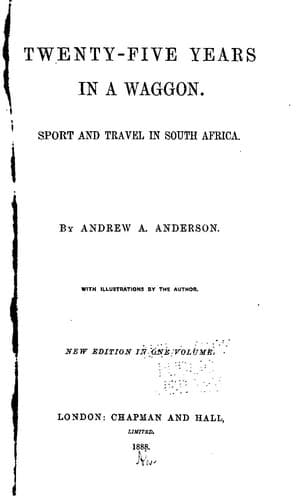
Twenty-Five Years in a Waggon in South Africa: Sport and Travel in South AfricaAnderson, Andrew A.
History
Twenty-Five Years in a Waggon in South Africa: Sport and Travel in South Africa
Anderson, Andrew A.
Africa, Southern -- Description and travel; Anderson, Andrew A. -- Travel -- Africa, Southern
turns south-east, following the river to Kumadua lake or vlei, which is
part of the Zouga river, then strikes east to Nchokotsa, and from thence
south-east to Mongwato, passing several pans, the most permanent waters
being at Klakane and Inkotsanges lime-pits. Where the road leaves the
Zouga there is a drift, and a road runs due north, passing through the
western end of the great Salt vlei Ntwetwe, on past the great baobab
letter-tree, passing a salt-pan on the left, crossing the road going to
the Victoria Falls, on to Kamakama, through the sandy forest of mapani
trees to the Mababe river and Linyanti on the Chobe, the chief Skeletu's
town. Several other roads cross this part of the desert from
Panda-ma-Tenka. The distance by road from Lake N'gami is 335 miles,
that is, 170 from the lake to Kumadua lake, and 165 from there to
Mongwato, consequently in a very dry season there is no water to be
obtained in this last distance, and where the trek Boers, in 1877, lost
so many of their people, oxen, and waggons. There are many hundred
pans, but dry in winter. There is game of every kind all over this
region, but they follow the water. The great brak pan, Makarakara, is
also dry at that time. When water is in, it is over fifty miles, both
north and south, quite an inland sea. Sand is everywhere, the roads are
fearful, quite up to the Mababe river.
Many of the mapani trees grow to a great size; the leaf has a sweet
gummy sort of varnish, of which the elephants are very fond. The palm
grows about forty feet in height; the wood is very hard, an axe with a
hard blow will not penetrate. The gigantic tree, the baobab, grows
extensively over all these regions. They are prominent objects in the
country through which you pass. Many of the stems exceed in
circumference 100 feet; their height is not in proportion to the bole;
few exceed eighty feet. The tree spreads and covers a large extent of
ground; the bark is used to make ropes, and blankets can be manufactured
from it. I obtained one, which is exceedingly strong. Bags are also
made to hold water or milk. The fruit is used to make a refreshing
drink. This tree is also called the Cream of Tartar; the fruit is
similar and much larger than an ostrich egg. These trees are calculated
to be, the largest of them, nearly 5000 years old.
Public-domain text, read in full here on John Shaqi.
Reviews
Reviews
No reviews yet
Be the first to share your thoughts on this work.
Elsewhere in the archive
Join the Discussion
Join the discussion
Sign in to leave a comment or review.
Sign InorCreate an account