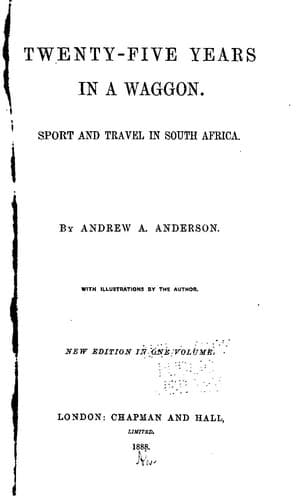
Twenty-Five Years in a Waggon in South Africa: Sport and Travel in South AfricaAnderson, Andrew A.
History
Twenty-Five Years in a Waggon in South Africa: Sport and Travel in South Africa
Anderson, Andrew A.
Africa, Southern -- Description and travel; Anderson, Andrew A. -- Travel -- Africa, Southern
I was pursuing my work in blissful ignorance of the many tears that had
been shed for the lone traveller in savage lands. When I came south,
after being buried three years, calmly treking along with my waggon,
oblivious of the scare I should create amongst my friends, so fully
convinced were they that the report of my death or murder was correct,
that, on presenting myself in the flesh, many of them could not for some
time realise they were looking upon a mortal man. Information was
forwarded to his Excellency the Governor, that I had turned up from the
far interior, in sound health and strength as man could wish to be.
The other occasion was when I was in the North Kalahara desert, away for
nearly three years, over all those northern regions up to the Zambese,
and in this particular region. Natives came down and reported to the
missionary at Secheles, that the Karkabrio Bushmen had burnt my waggon,
and that myself and people had been speared. Again the report was sent
on to the Government at Cape Town, and again my second resurrection took
place, much to the delight of my friends, who had given up all hope of
my ever returning from a country so entirely beyond the limit of the
hunter or the traveller. It is true, I have had some very narrow
escapes in passing through regions where hostile tribes occupy the
country; particularly in Damara and Ovampoland, and amongst the southern
Bushmen who once infested the Cape Colony. Fever and the perils of
hunting were never thought of. To avoid the former never take unboiled
water; weak cold tea, if possible, or weak brandy and water, will in a
great measure prevent it, with an occasional dose of quinine. Sunstroke
can also be avoided by wearing a very high-crowned, broad-brimmed felt
hat, with several holes as ventilators, with a light kerchief inside the
hat on the head, which cuts off the fierce rays of the sun from the
brain. Though I have spent so many years under a tropical sun, exposed
daily and all day long to its perpendicular rays, I have never once felt
the slightest indication of sunstroke, which I attribute to the above
precaution.
CHAPTER TWELVE.
THE KALAHARA DESERT. THE NORTHERN DIVISION IN THE ZAMBESE BASIN.
This region being the most extensive, and at the same time occupying the
greater portion of the interior of South Central Africa, claims special
attention in connection with the surrounding native tribes, all of whom
claim a portion adjoining their respective territories as their
exclusive hunting-ground.
In exploring an unknown country and meeting so many and such a variety
of people whose languages differ, it is not easy on making their first
acquaintance to grasp the different sounds that give meaning and
expression to their words. I noticed this particularly with respect to
the name of this desert region in connection with local names on its
borders. In writing down names from native pronunciation I wrote them
phonetically, using as few letters as possible.
Public-domain text, read in full here on John Shaqi.
Reviews
Reviews
No reviews yet
Be the first to share your thoughts on this work.
Elsewhere in the archive
Join the Discussion
Join the discussion
Sign in to leave a comment or review.
Sign InorCreate an account