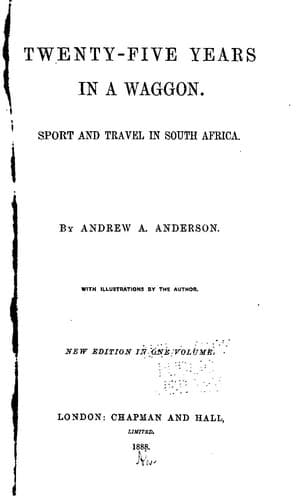
Twenty-Five Years in a Waggon in South Africa: Sport and Travel in South AfricaAnderson, Andrew A.
History
Twenty-Five Years in a Waggon in South Africa: Sport and Travel in South Africa
Anderson, Andrew A.
Africa, Southern -- Description and travel; Anderson, Andrew A. -- Travel -- Africa, Southern
Lake N'gami is situated nearly in the centre of the desert, to which two
of the most important northern rivers, Cubango and Quito, flow, uniting
in one, the Tonga, which enters the lake at the north-west corner in 20
degrees 25 minutes South latitude, 24 degrees 45 minutes East longitude,
at an altitude of 2813 feet above sea-level. The Cubango or Okavango
river, the source of which is much farther north than my explorations
extended, passes through a dense and impenetrable bush, extending on
both banks far away in 15 degrees South latitude, where there are
several tributaries falling in. Following the stream, which is broad
and in many places deep, with rapids and waterfalls at different points,
passing through forest and open country with native kraals situated on
its left banks, occupied by various tribes who are great fishermen and
have canoes, and where the hippopotami and crocodile abound, down to
where the Quito enters it in 17 degrees 10 minutes South latitude, on to
Debabe, a large native station, where the river turns south, branching
off into the Chobe and Zambese. The other branch takes its course to
Lake N'gami, and receives the Okayanka, which rises in Ovampoland and
flows east. All to the north of this river the country varies much in
character; the eastern portion is low with extensive swamps covered with
bush and fine timber, the western portion rises in ridges with lofty
plateaux covered with rich tropical plants and trees, including the
giant baobab; there are also extensive plains, with dry watercourses
crossing them towards the east; many of them have separate names under
the general name Omuramba.
The country to the west of the upper part of the Cubango, which is also
called the Okavango, is rich in timber and fine grasses, and game of
every description known in South Central Africa; this region is known as
Ombango, through which a road passes to the Cubango, and to the north is
the land of the Ambuelas, where the tsetse-fly is very common; it is
inhabited by the Kasaka and Ombango Bushmen. At the bend of the river,
at 16 degrees 20 minutes South latitude, the country rises in ridges
towards the north considerably, causing many rapids to be formed in the
stream. Below, the country is more level, until my station is reached,
where there is a hill on the right of the river, with many wherfs of
Bushmen, the altitude being 3370 feet above sea-level, and on the
opposite side of the river are many wherfs of the Ovampo, Karakeri,
Kororo, Ojego, and others, each with their separate chiefs; the most
important is the Ovakuenyami.
The river contains many varieties of fish, which the natives are very
expert in catching from their canoes by spearing and setting traps, as
also the hippopotami and crocodile.
Public-domain text, read in full here on John Shaqi.
Reviews
Reviews
No reviews yet
Be the first to share your thoughts on this work.
Elsewhere in the archive
Join the Discussion
Join the discussion
Sign in to leave a comment or review.
Sign InorCreate an account