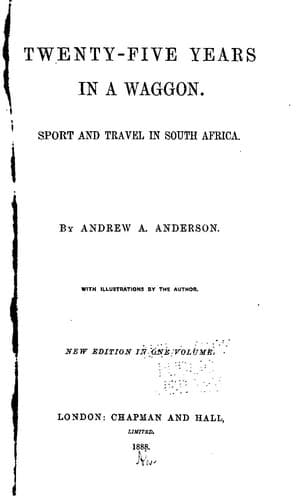
Twenty-Five Years in a Waggon in South Africa: Sport and Travel in South AfricaAnderson, Andrew A.
History
Twenty-Five Years in a Waggon in South Africa: Sport and Travel in South Africa
Anderson, Andrew A.
Africa, Southern -- Description and travel; Anderson, Andrew A. -- Travel -- Africa, Southern
rises in the Mitchell mountains, on the border of Great Namaqualand,
receiving the Kurick branch, passing through a beautiful and wild
country to the south of Nababis station. The three small tributaries of
the Great Fish river to the north of the Chun in 22 degrees 32 minutes
South latitude, are the Ganap, near Reheboth station; the Houra and
Manabis; south of the Chun are the Huntop, Koros, and the Amhup, all
receiving their water from the high lands of Great Namaqualand. The
principal stations on these rivers are the Amhup, Bethany, Kachasa,
Kawais, Reems, Hudenap, Brakhout, and a few others of recent date.
The inhabitants are of various tribes, called the Namaquas,
Veld-Schoeners, Bundelswaarts, Hottentots, Korannas, Kaffirs, Gobabies,
and Bushmen; some of the former cultivate the soil, use ploughs, and
keep cattle and sheep; they live near the small fountains and along the
river-banks, where they procure water by digging and permanent pits.
They live under petty captains. There are several mission stations.
Copper is found in many parts of the country, and copper-mines are
worked in the south near the Orange river. The geological formation is
granite, gneiss, trap, and amygdaloid. From the magnitude of this
river, it is evident the country at one time must have been well
supplied with rain, as it is a deep, broad, and stony stream, showing
how rapid must have been the flow of water down it. Fine timber and
bush grow in the kloofs and along the banks; many of the hills are very
picturesque, and the country produces fine grasses for cattle.
The trade of the country is greatly improving and is supplied by
colonial traders from Port Nolloth on the west coast in Little
Namaqualand, which is in the Cape Colony; a railway from that port to
the copper-mines on the Orange river has been for many years at work.
In the Kalahara desert on the east of the Great Fish river, and the
southern portion up to the Hygap river and south of the Brinus mountain
and Back river, are several stations and kraals. Nisbet or Barth is the
most important, where many Griquas are settled, also at Nabos, Luris,
Akuris, Blydver-Wagh, Aams, Oribane, Ariam, and others. The Griquas
cultivate the ground, and keep large herds of cattle and sheep, and
trade largely with the Cape Colony. Hottentots, Korannas, Bushmen,
Kaffirs, Namaquas, and small communities of other tribes live on the
banks of the Orange and along the streams, with their cattle-posts,
which of late years has greatly added to their wealth and enabled the
people to trade largely with the colony.
Public-domain text, read in full here on John Shaqi.
Reviews
Reviews
No reviews yet
Be the first to share your thoughts on this work.
Elsewhere in the archive
Join the Discussion
Join the discussion
Sign in to leave a comment or review.
Sign InorCreate an account