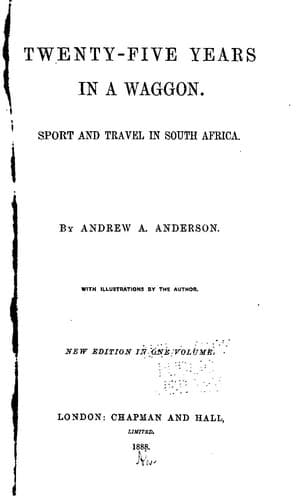
Twenty-Five Years in a Waggon in South Africa: Sport and Travel in South AfricaAnderson, Andrew A.
History
Twenty-Five Years in a Waggon in South Africa: Sport and Travel in South Africa
Anderson, Andrew A.
Africa, Southern -- Description and travel; Anderson, Andrew A. -- Travel -- Africa, Southern
The Kalahara, that portion, on the borders of Damara and Ovampolands for
300 miles, becomes much more densely wooded and hilly. Some of the
mountains attain a height of 8000 feet, in which lead, copper, iron, and
coal, also limestone, both white and dark grey, crop up everywhere.
Granite forms the hills. The Black and White Nosop and the Elephant
river, and their several branches, drain all this region. The country
is very dry, rain seldom falls, and when it does, it comes down with a
rush, which soon passes away; but the vegetation is excellent, fine
timber and thick bush predominate over this vast but little inhabited
country. The road from Walfish Bay on the west coast passes through, in
an easterly direction, to Lake N'gami, Zambese, Ba-Mangwato, and other
territories on the east. The road is difficult to travel for want of
water, but when the country is more opened up, means will be found for
procuring it by well-sinking and pumps, to make it as easy to travel as
any part of Africa. There are several permanent watering-places now
along this route. In the dry season it is three and four days' trek
between them, but as it is limestone nearly all the way, water can be
procured by digging wells. The country is subject to drought, more
particularly in the southern portion of the desert, consequently there
is more game to be found in the northern region. Elephants are seen in
troops of two or three hundred, also the zebra, and the various
antelopes, giraffes, rhinoceros, wild boar, and others.
The country is very favourable for rearing cattle; large numbers of
horses are yearly taken through the desert from the Orange River Free
State to Damaraland, and exchanged for Damara oxen, which are found to
make the best trek oxen, having small hoofs and being nimble on their
feet; they are compact and strong. Another advantage is that they are
bred on sour grass; when they arrive in the colony, it is sweet, which
improves their condition.
_April 30th_.--At Hoab, a lovely, calm morning, after a heavy rain last
night, at a vlei; there are several large ones in this open grass
country that contain water at this time of year, being the rainy season.
This station is on the desert-track from the lake to Ovampoland.
Public-domain text, read in full here on John Shaqi.
Reviews
Reviews
No reviews yet
Be the first to share your thoughts on this work.
Elsewhere in the archive
Join the Discussion
Join the discussion
Sign in to leave a comment or review.
Sign InorCreate an account