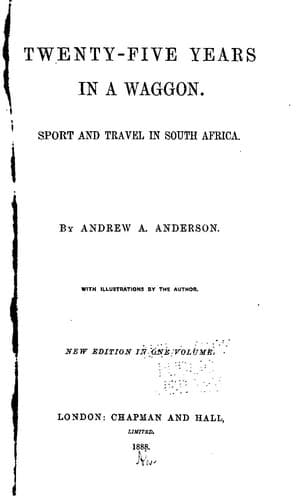
Twenty-Five Years in a Waggon in South Africa: Sport and Travel in South AfricaAnderson, Andrew A.
History
Twenty-Five Years in a Waggon in South Africa: Sport and Travel in South Africa
Anderson, Andrew A.
Africa, Southern -- Description and travel; Anderson, Andrew A. -- Travel -- Africa, Southern
The wild aspect of the country, bush here, open plains there, with long
ridges of low hills, no living soul to be seen until we arrived at the
pits, and there we found a small family, who on our approach ran into
the bush, but my own Bushmen called them back; they came very
reluctantly, but soon became friends, some fifteen in all, a little
dahka and a few beads as presents soon restored confidence amongst them.
I am much interested in the Bushmen of the desert, and also in the white
Bushmen of the Drakensberg mountains, because they appear from their
isolation from the outer world, and cut off as they have been from the
tribes that now occupy the regions around them, to be the descendants of
the people who occupied the lower end of this ancient continent before
the tribes from the north came down, and pushed their way south,
bringing with them their Asiatic and Hebrew customs, which all without
exception now practise more or less, evidently proving from what regions
they had migrated. Eventually they nearly penetrated to Cape Town. Not
so with the white Bushmen of the Drakensberg, the Hottentots, or Bushmen
of Cape Colony, and the Bushmen of the Kalahara Desert, each retaining
up to the present time distinctive physical formations and distinctive
dialects, so entirely different from those tribes that come down south
and overrun the southern peninsula of the African continent. These
ancient aborigines of South Africa are comparatively pigmy races to
those above referred to, who are as tall, robust, well-formed specimens
of the human race as can be found in any part of the world. Then again
their language, if it can be called such, is entirely different from any
other known tongue, their thoughts are described by certain clicks, four
in number, the white Bushmen of the Drakensberg have only these clicks,
the Hottentots or Bush men of the Cape have, in addition to the clicks,
sounds which accompany the clicks which come from the throat like
grunts. The Bushmen of the desert have also these clicks, showing, I
think conclusively, that these early people were in existence before
languages,--what we understand by language, words formed by the mouth,
tongue, and lips, as the nations of the world now converse and talk.
Some of the South African missionaries have committed to paper these
clicks, and they state it is a most beautiful and expressive language.
At any rate, my belief is, that the earliest formed language of man was
by sounds such as clicks and grunts before they advanced so far as to
express their ideas by forming words, and language has been progressive
as man advanced in civilisation. In travelling over South Africa and
listening to the sounds of the baboons as they move about the rocks
above you, you can detect a great similarity in their guttural sounds
and the Bushman language, and I could quite understand when my Bushman
told me he could converse with, and knew much of what these said,
showing a connecting link between them.
Public-domain text, read in full here on John Shaqi.
Reviews
Reviews
No reviews yet
Be the first to share your thoughts on this work.
Elsewhere in the archive
Join the Discussion
Join the discussion
Sign in to leave a comment or review.
Sign InorCreate an account