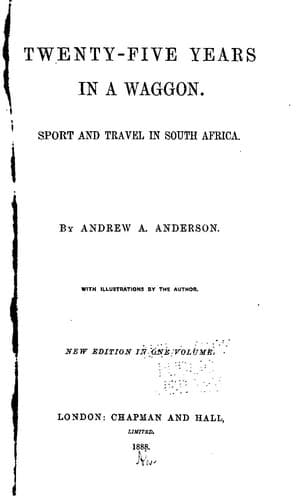
Twenty-Five Years in a Waggon in South Africa: Sport and Travel in South AfricaAnderson, Andrew A.
History
Twenty-Five Years in a Waggon in South Africa: Sport and Travel in South Africa
Anderson, Andrew A.
Africa, Southern -- Description and travel; Anderson, Andrew A. -- Travel -- Africa, Southern
The country is not a pleasant region to travel through, for several
reasons--the scarcity of water, and that brackish; the want of grass;
the native cattle, where it would be good, keep it short; and the
wandering tribes are constantly annoying and worrying for something. On
the banks of the Great Fish river, near the Brinus Mountains, I shot a
black wolf, the first I had seen, and my people told me they were very
rare. I had great difficulty in getting through the country--bad roads
and dreadful drifts crossing the rivers.
I have little to relate of my explorations of this part of Africa, my
time being taken up in surveying the country, and collecting specimens.
The entire coast is a barren waste, not suitable for emigrants or
anything else for fifty miles at least inland.
CHAPTER FOURTEEN.
DAMARALAND. SOUTH CENTRAL AFRICA.
The boundary of this region, adjoining Great Namaqualand, Kalahara, and
Ovampo, is very undefined. The natives are unacquainted with the true
divisions, and as each nationality is not confined to any particular
line, living in a kind of mixed community, it is difficult to say where
one country begins and the other ends; but from accounts of the people,
it appears that the extinct river Kuisip, which enters Walfish Bay, is
the correct boundary, and the coast-line to the north reaches to the
Cunene river, which is also the Portuguese boundary of Bengulo, the
distance being nearly 400 miles.
The first and only harbour is Walfish Bay, being an important
trading-station, belonging to the Cape Colony. This port, where there
are two trading establishments, supplies the whole of the northern part
of Great Namaqualand, and also all Damara and Ovampolands, the central
and northern Kalahara, as far as Lake N'gami. The great drawback to its
prosperity is want of fresh water. In many cases the people are
supplied with water in casks from Cape Town, but I believe if proper
means are taken by sinking wells, a good supply can be procured. At
present a considerable trade is carried on with the natives, and is on
the increase. On the north of this bay the river Swakop enters the
Atlantic, which is the main and principal stream that drains the eastern
division of Damaraland, upon which are situated many natives' wherfs.
Some of the principal are Oekiep, thirty-six miles up the river, then
Tineos, Oijimbinque, Otjimonjebba, Okandu, Little Barmen, Great Barmen,
Otjithebba, Gous, Eikham Hot Springs, and Thames Mission Station. The
distance of this last station by road to Walfish Bay is about 231 miles,
which is one of the roads to Lake N'gami, and is on the north of Awas
mountain, that attains an elevation of 6400 feet. The scenery in this
region is wild and grand, and eastward of these points the Ealahara
comes in, and is drained by the Black and White Nosops, Elephant river
and branches. South of Swakop are several native kraals and wherfs;
Wittwater, Reed Fontain, Tjobis, Platklip, Onanis Mission Station on the
Public-domain text, read in full here on John Shaqi.
Reviews
Reviews
No reviews yet
Be the first to share your thoughts on this work.
Elsewhere in the archive
Join the Discussion
Join the discussion
Sign in to leave a comment or review.
Sign InorCreate an account