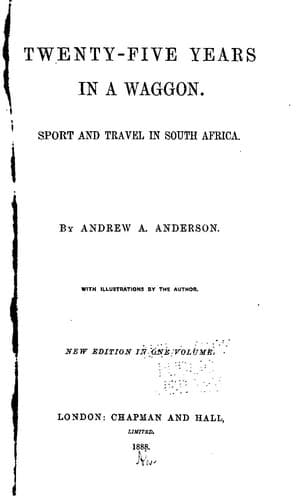
Twenty-Five Years in a Waggon in South Africa: Sport and Travel in South AfricaAnderson, Andrew A.
History
Twenty-Five Years in a Waggon in South Africa: Sport and Travel in South Africa
Anderson, Andrew A.
Africa, Southern -- Description and travel; Anderson, Andrew A. -- Travel -- Africa, Southern
The country on the south side of the watershed or high veldt is open and
uninteresting, long stretches of rolling plains, not a bush or tree to
be seen for miles; except here and there, at long intervals, a Boer farm
is seen, and near it occasionally a garden surrounded by the well known
tall gum trees; no Kaffir locations are seen in any portion of this
part, a few huts occupied by the Kaffir servants may be located near
each farm. The country is suitable for cattle, but sheep do not thrive.
This country is divided into thirteen districts--seven in the Limpopo
basin, and six in the Orange and Vaal basins.
The first contains Pretoria, Rustenburg, Marico, Waterburg,
Zontpansberg, Lydenburg, and Middleburg.
The second Potchefstroom, Bloemhof, Heidelburg, Wakkerstroom, Utrecht,
and Standerton.
The white population, which was estimated in 1882, did not exceed 45,000
of all nationalities. Since the retrocession of the Transvaal it has
greatly diminished, probably not more than 40,000 at the present time;
putting five to a family, on an average, there would be 8000 families,
2000 of which would be made up of English, French, Germans, Hollanders,
and other Europeans, to occupy this extensive country, which, deducting
for native tribes, leaves for each white individual, great or small, 700
acres, and yet the Boers are not content with this large share, but must
make war on native tribes to possess themselves of more. If they were
an industrious and well-disposed people, and cultivated their lands in a
proper way, the Transvaal would, and ought to be, the most prosperous
and well-to-do country in South Africa, having all the advantages of a
subtropical climate, plenty of water (if properly utilised) for
cultivation, abundance of coal and other minerals, splendid grazing for
cattle, and many other advantages; but no, they would sooner expend
their energies in fighting the native tribes and stealing their cattle,
because it pays them better, than devote their time to peaceful
pursuits. From the time the Boers have held the Transvaal they have
pursued this policy--as is well known by every colonist in the country,
and nothing but a firm Government will ever bring them into a civilised
state, and prevent their atrocities from being further perpetrated, as
has lately occurred on their north-west border and in Zululand.
The splendid position the Transvaal occupies in South Africa, with all
the advantages above stated, the proximity to Natal, and the seaports of
Durban and Delagoa Bay, and eventually a railroad from Newcastle to
Pretoria, as also from Kimberley and Delagoa Bay, shows that this
country has great facilities for supplying the native trade in the
north-east of South Central Africa, where the population is great, and
the country rich in all kinds of produce. The gold will soon bring all
this.
CHAPTER SEVENTEEN.
A BRIEF HISTORICAL SKETCH OF THE TRANSVAAL FROM 1825 TO 1877.
Public-domain text, read in full here on John Shaqi.
Reviews
Reviews
No reviews yet
Be the first to share your thoughts on this work.
Elsewhere in the archive
Join the Discussion
Join the discussion
Sign in to leave a comment or review.
Sign InorCreate an account