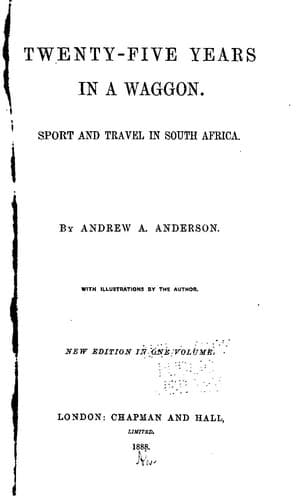
Twenty-Five Years in a Waggon in South Africa: Sport and Travel in South AfricaAnderson, Andrew A.
History
Twenty-Five Years in a Waggon in South Africa: Sport and Travel in South Africa
Anderson, Andrew A.
Africa, Southern -- Description and travel; Anderson, Andrew A. -- Travel -- Africa, Southern
These salt-pans are quite dry and free from water for some four or five
months a year, when there is no salt to be seen, and it is not until the
rainy season is over, and the water that has collected in the pans
during that time (some two feet deep) has in the course of a few months
evaporated, that the salt appears to have been drawn from the deposit
below to the surface by the action of the water upon it, and a thick
deposit is left, which is collected by the proprietor, and sold at
various prices. I have paid for a sack containing 200 lbs. 3 shillings
and sometimes 5 shillings, according to the supply and demand. Some
salt-pans do not give a sufficient deposit to pay the cost of
collecting. There is a great sale for it throughout the country; but
table-salt is supplied from England, as there has been no means of
cleaning the native salt from the impurities it contains. The Boers and
natives use it. Some of these salt-pans will yield in the season nearly
1000 nuids of 200 lbs. each, and yet there appears to be no diminution
in the supply, showing there must be extensive deposits beneath the pan
beds. And so impregnated are some portions of these extensive grass
plains that the grass that grows upon them is called the sour veldt, and
other parts, where the surface-soil has been washed down from a higher
level and deposited on the flats, is called the sweet veldt. The sour
veldt is easily distinguishable by the white coating on the ground,
which the oxen lick when they want salt.
I always kept my oxen in good condition by giving them salt, once or
twice a week, from a supply kept in the waggon for them, and it is a
great preventative also against that common sickness the lungsick, which
is very fatal to oxen all through South Africa. There are several salt
and brack-pans in the northern division of the republic, but the most
numerous and the largest are to the south of New Scotland. Lake Cressie
is the most extensive, in shape something like a horse-shoe, and nearly
twenty miles round, lying in an open grass country with few bushes. The
water in it is permanent, and cannot be very brackish, as a hippopotamus
has been known to live in it since it was first discovered. The road
from Lydenburg to Wakkerstroom passes on the east side of the head of
Lake Cressie, where there is a store, and a more desolate-looking
country to pass through is rarely to be found.
Public-domain text, read in full here on John Shaqi.
Reviews
Reviews
No reviews yet
Be the first to share your thoughts on this work.
Elsewhere in the archive
Join the Discussion
Join the discussion
Sign in to leave a comment or review.
Sign InorCreate an account