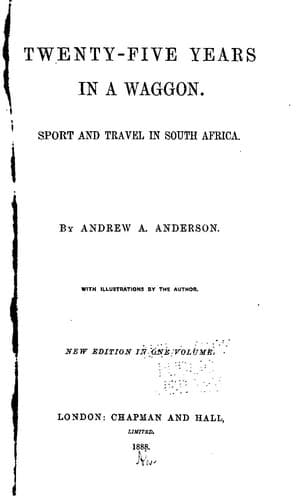
Twenty-Five Years in a Waggon in South Africa: Sport and Travel in South AfricaAnderson, Andrew A.
History
Twenty-Five Years in a Waggon in South Africa: Sport and Travel in South Africa
Anderson, Andrew A.
Africa, Southern -- Description and travel; Anderson, Andrew A. -- Travel -- Africa, Southern
Over this interesting deposit there is a large wood with limestones
cropping up above the soil. Upon one of them I saw several loose
egg-shaped stones, and others perfectly round, the size of a sparrow's
egg, lying on the ground close to the rock. On stopping to pick them up
I found the stone full of them, some half buried, others only holding by
a small part of the ball fixed to the rock. Thinking it a very
interesting specimen I went to my waggon for a hammer, and secured one
of the projecting parts of the rock that had some of these balls
imbedded in it, and a dozen of the loose balls, which have been
carefully preserved to be examined by a geologist when time will permit,
to ascertain if this singular formation is limestone or not, as every
portion of this limestone formation is black except where the bones are
found, and there it is of a light-brown colour. It is also found in all
the dark rocks in the same locality. Extensive tracts of country in
South Central Africa have similar rocks containing crystallised
globules, which when broken are hollow, which leads me to suppose this
rock is not a limestone formation. Dr. Lyle, the geologist, at
Pretoria, examined the rock with bones in it, and pronounced it a kind
of lava impregnated with lime from the bones.
In the neighbourhood of Lydenburg, to the north, are many extensive
caves, some extending for nearly a mile underground, that have been
formed by the small stream of water that flows through most of them,
with beautiful stalactite hanging from their roofs and sides. A short
distance to the west of these were the strongholds of the chiefs Secoeme
and Mampoer. These mountains are completely riddled with caves, and are
places of great strength, and surrounded by many Kaffir kraals, under
several petty chiefs. The most noted are Magali, Manpartella,
Secocoene, Matebe, Maselaroon (Queen), Mapok, Mamalube, Umsoet, Moripi,
Umlindola, Majaje (Queen), Maffafare, Mayaya, and others, numbering many
thousands in all. During the Secocoene war, in 1878, I was through that
country, travelling up from Pretoria with a detachment of the 80th
Regiment, and visited the magnet heights, a range of hills composed
entirely of loadstone of highly magnetic power. It is about forty miles
to the north-west of Lydenburg.
Public-domain text, read in full here on John Shaqi.
Reviews
Reviews
No reviews yet
Be the first to share your thoughts on this work.
Elsewhere in the archive
Join the Discussion
Join the discussion
Sign in to leave a comment or review.
Sign InorCreate an account