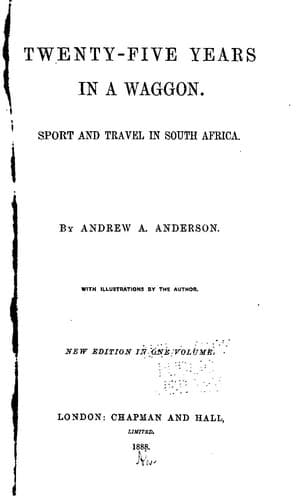
Twenty-Five Years in a Waggon in South Africa: Sport and Travel in South AfricaAnderson, Andrew A.
History
Twenty-Five Years in a Waggon in South Africa: Sport and Travel in South Africa
Anderson, Andrew A.
Africa, Southern -- Description and travel; Anderson, Andrew A. -- Travel -- Africa, Southern
The Tati gold-fields occupy the western border on the north bank of the
Tati river, which were first discovered by Mr. H. Hartly, the well
known and highly-respected elephant-hunter from the interior, in 1867,
which soon became known, and a number of diggers from Australia and
other parts came flocking to the scene. Amongst the number was Sir John
Swinburne. A company was formed, and after spending much money in
machinery and other works, it was abandoned, sufficient gold not being
found to pay expenses. The stores and works fell into ruin, and the
last of the powerful engines, weighing several tons, was washed down the
river nearly two miles, and deposited on the bank some twenty feet above
the river-bed, where I saw it when returning from Matabeleland in 1878.
The fact of the flood-waters carrying down such a huge and heavy mass as
this engine two miles, and depositing it at so high a level, will give
some idea of the force and quantity of the water that fills these rivers
during that time. The rainy season varies as to time; sometimes it
commences early in November, at others later, and lasts until February
or March. In all these tributaries of the Limpopo that drain the above
region, none retain water throughout the year, although they are large
and broad streams with steep and lofty banks, but during the dry season
water may be obtained from most of them by digging a few feet in their
sandy beds; they are all at too sharp an angle to allow water to remain
in them. The main road from Ba-Mangwato to Matabeleland crosses most of
them, and frequently I have had to wait weeks on their banks until the
flood-water had subsided to enable me to cross. On one occasion I was
on the point of crossing the Bamakaban river, and was treking down the
bank to enter it with my waggon, when my driver called my attention to a
great roaring sound which came from the up-river side. Having
previously had several days of storms, with heavy rains, we held still
to listen, and from previous experience we too well knew the cause.
There was not time to cross and reach the opposite side before the rush
of water would be upon us, particularly with an ox-waggon, as the sand
in these river-beds is very heavy for oxen to pull a waggon through, and
sometimes they take it into their heads to come to a stand until they
think proper to move on again, after a little coaxing with one or two
South African waggon-whips, the handles of which are twelve feet long,
and the lash twenty. Therefore, to prevent any catastrophe, we selected
a pretty open grassy glade on the wooded bank, and outspanned; but
before we had completed this operation, the water was in sight, coming
down like a wall, bringing trees of considerable size, large stems of
dead wood, sticks, and froth, rushing and tearing along with a roaring
sound that could be heard miles away, and in a few minutes there was
sufficient to float a large ship. Where would my waggon have been if I
Public-domain text, read in full here on John Shaqi.
Reviews
Reviews
No reviews yet
Be the first to share your thoughts on this work.
Elsewhere in the archive
Join the Discussion
Join the discussion
Sign in to leave a comment or review.
Sign InorCreate an account