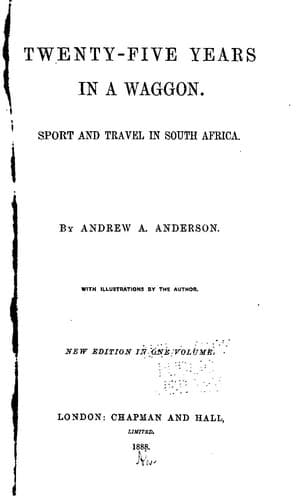
Twenty-Five Years in a Waggon in South Africa: Sport and Travel in South AfricaAnderson, Andrew A.
History
Twenty-Five Years in a Waggon in South Africa: Sport and Travel in South Africa
Anderson, Andrew A.
Africa, Southern -- Description and travel; Anderson, Andrew A. -- Travel -- Africa, Southern
The missionary stations in this country are at Inyatine, where the Rev.
Mr. Sykes has for many years been doing duty. The late Rev. Mr. Thomas
formerly lived there, but he afterwards removed down to Shiloh. The
former is sixty miles north of Gubuluwayo, the latter about thirty miles
in a north-west direction. Hopefountain is four miles to the north of
this military station, where the Rev. Mr. Thompson formerly lived;
afterwards the Rev. Messrs. Elms and Elliott, all of whom are under the
London Missionary Society.
Inyati, afterwards altered to Inyatine, was the first royal residence of
the dreaded Umselekatze, who ruled his people with a rod of iron, and
kept an army of over 8000 warriors, and could bring more into the field
if required. He was a king who knew how to rule his people; a splendid
warrior himself, he took care that his troops should be so likewise. He
died in 1869, and at his death there was a dispute as to who should be
his successor. Kuruman, his son by a royal wife, was supposed to be
living in Natal, instead of being killed by order of his father; but on
inquiry it was stated he had been killed.
Lo-Bengulu, on the 25th January, 1870, was proclaimed king with groat
rejoicings. Warriors to the number of 10,000 assembled at the king's
kraal, dressed in full war costume, a helmet of black ostrich feathers,
capes and epaulets of the same, strips of cat-skins for their kilts, and
other ornamentations on their legs. Armed with short stabbing assagais
and shields of oxhide, they formed a circle some twenty deep, paying
homage to their new king, singing his praises, keeping time with their
feet, and going through various performances, after which a great
slaughter of oxen took place, with feasting and Kaffir beer, terminating
the day's proceedings. He has reigned up to the present time without
any disturbance amongst his people.
The Mashonas are a separate race from the Matabele, who originally were
pure Zulus when they came into this country with their chief
Umselekatze, or as he was better known under the name of Moselikatze.
Since then many of them have taken to wife the young girls of the
Mashona tribe. The great men and high-caste Zulus take pride in keeping
themselves pure from any mixture with other races, and in walking
amongst them in their kraals a marked difference is seen. The pure
Matabele is a fine specimen of the human race; tall, well-made, with
regular features and an upright bearing. Lo-Bengulu allows these
marriages, as it tends to unite the nation closer together. Generally
they look upon the Mashonas as dogs.
Public-domain text, read in full here on John Shaqi.
Reviews
Reviews
No reviews yet
Be the first to share your thoughts on this work.
Elsewhere in the archive
Join the Discussion
Join the discussion
Sign in to leave a comment or review.
Sign InorCreate an account