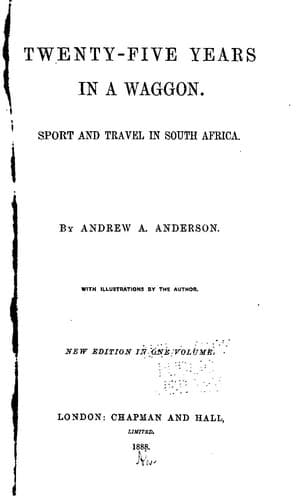
Twenty-Five Years in a Waggon in South Africa: Sport and Travel in South AfricaAnderson, Andrew A.
History
Twenty-Five Years in a Waggon in South Africa: Sport and Travel in South Africa
Anderson, Andrew A.
Africa, Southern -- Description and travel; Anderson, Andrew A. -- Travel -- Africa, Southern
But when the time comes, and the people of the Cape Colony are more
alive to their own interests, instead of living in their present dormant
state, devoting their attention to subjects of no real importance to
their prosperity, they will see how vital it is to their interests to
have a central railway up through Africa to the Congo basin, and to draw
a vast trade south, that would otherwise flow to the west coast, and all
the country that is situated on the north side of the Zambese river, up
to what is included in the Congo state, a region of untold wealth,
teeming with elephants, ostriches, and every kind of large game; thickly
populated by intelligent races, who are alive to the advantage of those
comforts that civilisation brings into the country. From a want of
forethought the colonists have lost the west coast, and as far inland as
the 20 degrees East longitude, and they will find the Germans no mean
competitors in the interior trade of that vast region.
The Barotse tribe, in particular, which is very numerous, has already
received great benefit from the English trade introduced first into the
country by Mr. Westbeech at the chief's kraal on the north side of the
Zambese, and afterwards by other traders, when the chief Secheke was
alive.
The extent of this region north of the river, within a reasonable
distance of a railway at the Victoria Falls, is 150,000 square miles.
The distance of railway carriage from the Zambese river to Kimberley is
770 miles, to where a railway is already being constructed. A single
line could be made at a trifling cost, as the country through which it
would pass is comparatively a dead level; and beyond the Vaal river at
Barkly, where a bridge is now being erected, only a few small streams
would have to be crossed.
The distance is less by several hundred miles from the above region to
Kimberley over an easy route, than it is to the Congo river through a
difficult and mountainous country, where large rivers would have to be
bridged, making a line almost impracticable. Such a line would also
open up the country on the south side of the Zambese river. Towns would
spring up, and the advantages to the Cape Colony would be incalculable.
If fifty miles at a time were laid down and completed, or more, if funds
could be obtained, it would not take many years to accomplish this grand
object. It would be far more to the advantage of the Colony and English
trade in time than extending the railway from Kimberley to the
Transvaal, although the commerce may be largely increased under the
present Boer rule, with whom we should have trouble in the duties they
would levy on every article entering or leaving the state.
Public-domain text, read in full here on John Shaqi.
Reviews
Reviews
No reviews yet
Be the first to share your thoughts on this work.
Elsewhere in the archive
Join the Discussion
Join the discussion
Sign in to leave a comment or review.
Sign InorCreate an account