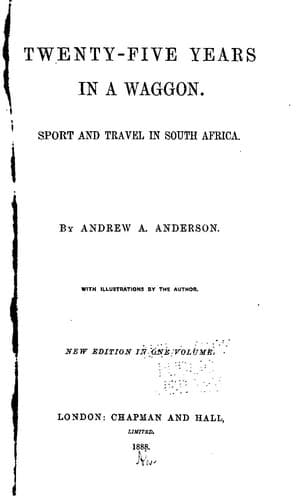
Twenty-Five Years in a Waggon in South Africa: Sport and Travel in South AfricaAnderson, Andrew A.
History
Twenty-Five Years in a Waggon in South Africa: Sport and Travel in South Africa
Anderson, Andrew A.
Africa, Southern -- Description and travel; Anderson, Andrew A. -- Travel -- Africa, Southern
words, full employment for our workpeople; for no other policy will put
bread into their mouths. If this contemptible party spirit, which has
now grown rampant, should increase, England's greatness is on the wane,
for where a house is divided against itself, it cannot stand. This
spirit, of opposition in time becomes a mania, and the most vital
interests of our country are sunk in the glory, as they imagine, of
turning out their opponents from office. I hope all who wish for the
prosperity of Great Britain will rise to the occasion and become what
their forefathers were, staunch and determined upholders of British
interests, which means prosperity to her people, where the weal of Great
Britain is concerned, and sink that petty and unpatriotic spirit. My
fate most probably would have been similar to those unfortunate men, as
it was known I was on a mission into that country also. I might have
gone and never been heard of more, a satisfactory conclusion to arrive
at.
The Mashona country in the north is but little-known, from the
difficulty thrown in the way of exploring it, particularly along the
south side of the river Zambese; gold in large quantities is known to be
there, as also other minerals. On the north side of the river gold has
been found, but until some better mode of transit is adopted, such as a
single line of railway, with shuntings at stated distances, the richness
of these regions cannot be developed. A railway would revolutionise the
whole country, to the immense advantage of our Cape Colony and Great
Britain, and the civilisation of the native tribes.
When Lo-Bengulu became king, in January, 1870, it was supposed the
rightful heir to the throne, "Kuruman," born from a royal wife of
Moselikatze, was dead, killed by order of his father, as it appears
there was a conspiracy amongst the Indunas to dethrone him, and place
Kuruman in his place. Moselikatze, hearing of this, as he was out with
an army making conquest in the northern part of the Mashona country,
immediately returned and made an attack on a kraal where these Indunas
had assembled, Inthaba Inisduna, and slaughtered them and all the
people, except Lo-Bengulu, who was his son by another wife, but made a
royal child--and with those slaughtered, it was supposed Kuruman was
one, but it was found afterwards he had escaped. Moselikatze sent for
him, and ordered a Basuto to take him away and destroy him, but he was
not to injure his person, that one belonging to royalty should not be
mangled.
Public-domain text, read in full here on John Shaqi.
Reviews
Reviews
No reviews yet
Be the first to share your thoughts on this work.
Elsewhere in the archive
Join the Discussion
Join the discussion
Sign in to leave a comment or review.
Sign InorCreate an account