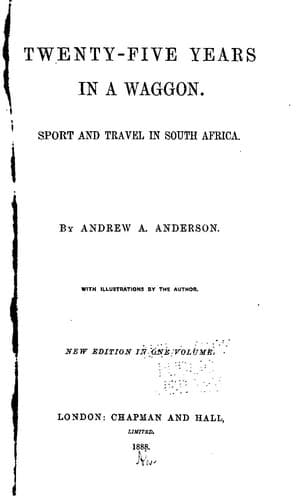
Twenty-Five Years in a Waggon in South Africa: Sport and Travel in South AfricaAnderson, Andrew A.
History
Twenty-Five Years in a Waggon in South Africa: Sport and Travel in South Africa
Anderson, Andrew A.
Africa, Southern -- Description and travel; Anderson, Andrew A. -- Travel -- Africa, Southern
Besides the gold-mines in other districts, which will be described in
dealing with the adjoining kingdom of Umzela, there are other
indications of the presence of a civilised people in remote times;
throughout this region known as the Royaume du Quiteve, and Etats du
Monomotapa, the residence of the Emperor Quiteve, and also to the north
is the Ville Royal du Monomotapa, which is situated in ancient
Portuguese maps as being in the northern division of the Mashona
country, on the south side of the Zambese, under the name Monomotapa, in
the Abutua and Banyai regions; the emperor of whom, in 1550, was
conquered by the Portuguese, so they say, and ceded his dominion to
them. Now it is an interesting question, what tribe or nation did these
emperors spring from? It appears certain that they must have been in
possession of the country long before the Portuguese rounded the Cape of
Good Hope, and proceeded as far north up the east coast to Mozambique,
including Quillimane and Delagoa Bay, in 1497, under Vasco de Gama; but
he made no settlements on the coast at that time. Bartholomew Diaz, in
1486, rounded the Cape and proceeded as far east as Algoa Bay, and
planted a cross on St. Croix Island, then on to the Great Fish river,
and returned. Sofala was visited by a Portuguese traveller from
Abyssinia in 1480. In 1500, the Portuguese began to form settlements on
the west coast; 1506, town of Mozambique taken by the Portuguese under
Tristan d'Acunha; 1507, Portuguese proceed with their conquests on east
coast, and in 1508, conquer Sofaia. Therefore it was impossible for the
Portuguese to establish themselves to any great extent on the
coast-line, much before the time it is stated they conquered the Emperor
of Mouomotapa.
A Venetian map published in 1546 gives an outline of the Zambese river
and the Central African lakes, and I have an ancient map of Africa
showing several lakes in that region, particularly Lake Tanganyika,
which very correctly shows its true position, clearly proving that it
was discovered long before Livingstone or any other modern explorer ever
visited that central region.
Were these Monomotapa people black or white, and from whence did they
come? They were evidently a separate people from those who now occupy
the country. May not an Arab tribe have passed down along the east
coast, and established themselves in the Mashona region, and formed a
kingdom? for the word Emperor is not a word used by any African races
south of the Zambese, and none, I believe, except they are of Arab
blood, or closely connected with that race. There is at present that
tribe mentioned in my description of the northern Kalahara desert, on
the Quito and Cubango, to the north of my explorations, that are termed
white; may not this remnant be descendants of the Monomotapa people, and
those white the Mashonas call "Abbalamba," who may also have formed a
part of the Emperor Quiteve's people?
Public-domain text, read in full here on John Shaqi.
Reviews
Reviews
No reviews yet
Be the first to share your thoughts on this work.
Elsewhere in the archive
Join the Discussion
Join the discussion
Sign in to leave a comment or review.
Sign InorCreate an account