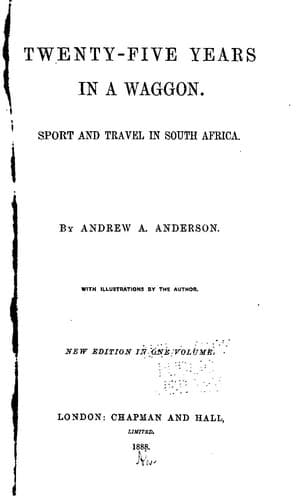
Twenty-Five Years in a Waggon in South Africa: Sport and Travel in South AfricaAnderson, Andrew A.
History
Twenty-Five Years in a Waggon in South Africa: Sport and Travel in South Africa
Anderson, Andrew A.
Africa, Southern -- Description and travel; Anderson, Andrew A. -- Travel -- Africa, Southern
There are several small rivers north of the Buzi to the mouth of the
Zambese, that drain the coast-line, which is very flat and marshy. The
tributaries of the Zambese are the Zangwe, Sankatsi, Mowila--the main
branch of the Mazoe enters the river below Tette--Nake, Zingesi, and
Panyame. In the northern portion, between the Mashona and Zambese, are
many isolated and extensive hills,--Vimga, Nadsu, and Vimiga, drained by
the Nake and Zingesi. To the east of these hills is the Lobolo
mountain, with its many spurs, and more to the east the Moltkeberg,
drained by the Mazoe and its tributaries, Gaverese, Upa, Janhambe,
Jankatse, and others of smaller note, all which are in the Zambese
basin, which includes also--lower down that river--the Mowila, Sankatsi,
and Zangwe.
The country towards the sea is flat and most uninteresting. There are
several low ranges of hills in outlying districts. The country
generally is dense bush, and full of game. The Portuguese possessions
do not extend many miles beyond the south bank of the Zambese river.
The chiefs in those districts claim up to that line.
The altitude of the Lombolo mountain is 4200 feet, and the Moltkeberg
3700 feet above sea-level. The general rise of the country is 1700
feet, gradually sloping towards the Zambese and coast. The northern
division is divided into different tribes under their respective chiefs.
The Banyai country is between the Mashona and Zambese, in which is
situated the Portuguese town of Tette, on the banks of the Zambese.
Pretty and picturesque country around, with fruit of every kind, melons,
oranges, lemons, sweet potatoes, pines, and every kind of vegetable; but
the Portuguese are so lazy that everything is left almost to nature.
The river is navigable for small steamers for seventy miles above Tette,
which is situated 260 miles from its mouth. Magnificent timber trees
grow in the valleys, and on the slopes of the hills ivory palm, Mali
palm, the palm that grows to the height of eighty feet; the seed of the
fruit is eaten by the natives; it grows in the uplands, and down on the
low-lying swampy country. Mashola, a tree that bears a round fruit
similar to the Kaffir orange. The india-rubber tree is very common; the
fruit can be eaten. The Umtonto tree is used for making baskets and
other things. Large tracts of country are covered with the Mowasha
bush, mahogany, and ebony up in the hill districts, and all similar
trees found growing in the Mashona country are found there.
Public-domain text, read in full here on John Shaqi.
Reviews
Reviews
No reviews yet
Be the first to share your thoughts on this work.
Elsewhere in the archive
Join the Discussion
Join the discussion
Sign in to leave a comment or review.
Sign InorCreate an account