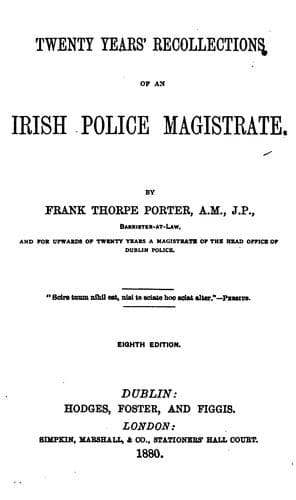
Twenty Years' Recollections of an Irish Police MagistratePorter, Frank Thorpe
History
Twenty Years' Recollections of an Irish Police Magistrate
Porter, Frank Thorpe
Crime -- Ireland; Criminals -- Ireland; Ireland -- Social life and customs; Porter, Frank Thorpe, 1801-1882
As to the infractions of the Customs laws, my cases all consisted of
tobacco or brandy, and the seizures were, in almost every instance,
effected immediately on the arrival in port of the respective ships. I
believe that the intelligence of smuggling ventures being on board was
almost always furnished by those from whom the contraband articles were
purchased, or by the attendants in taverns or liquor shops, before whom
unguarded conversations might have occurred, and in some instances from
both sources. According to my recollection, the great majority of
detections occurred on board vessels coming from places belonging to the
British Crown. Jersey contributed largely to the contraband traffic,
Gibraltar afforded an occasional venture, and the timber ships from the
British provinces in North America were frequently made available to the
illicit importation of tobacco. A fine brig from St. John's, New
Brunswick, named, as well I can remember, "The Hope," arrived in Dublin
in the summer of 1852. She was boarded in the bay by some officers of
Customs, to whom the master stated that his cargo was exclusively
timber. No other description of goods was mentioned in the vessel's
papers. The officers proceeded to raise some boards at the foot of the
cabin stair, and took out a large quantity of Cavendish tobacco. They
then entered the cabin and removed some other boards, finding an
abundance of tobacco, which had been there concealed. The master was
arrested, and having been brought before me, I remanded the case, by the
wish of all parties, for a week. The revenue authorities did not
institute any proceedings involving the condemnation of the brig, but
they sought the conviction of the master, who was adjudged by me to pay
two hundred pounds, or in default of such payment, to be imprisoned for
six months. His wife had been the companion of his unfortunate voyage,
and their separation, on his committal to prison, was extremely sad. He
was a fine-looking young man; I think his name was Harris, and he stated
that he belonged to St. John's. The wife was also a native of that
place, and I never beheld a woman who, in my opinion, surpassed her in
personal beauty. Moreover, she was very near the time when to the
designation of "wife" the term "mother" would be added. Whilst I
condemned the man I deeply commiserated the woman, and all who witnessed
their parting sympathized in her affliction. At the Richmond Bridewell,
he was treated with much kindness, and was frequently allowed access to
the gardens, to which, as well as to his prison-room, his wife was
constantly admitted. There was a young man confined at that time at the
instance of some of his relatives. He was a very extraordinary person.
In him great literary attainments were combined with imaginative power:
he had a mind which could
"Give to airy nothing
A local habitation and a name."
Public-domain text, read in full here on John Shaqi.
Reviews
Reviews
No reviews yet
Be the first to share your thoughts on this work.
Elsewhere in the archive
Join the Discussion
Join the discussion
Sign in to leave a comment or review.
Sign InorCreate an account