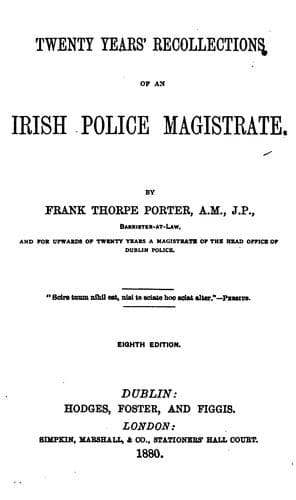
Twenty Years' Recollections of an Irish Police MagistratePorter, Frank Thorpe
History
Twenty Years' Recollections of an Irish Police Magistrate
Porter, Frank Thorpe
Crime -- Ireland; Criminals -- Ireland; Ireland -- Social life and customs; Porter, Frank Thorpe, 1801-1882
dressed in deep black. She appeared in great affliction, but was
accorded no sympathy. No one thought that anyone else had a right to be
sad when the King was in Ireland. I subsequently saw the "woman in
black," at the review in the Phoenix Park, vainly endeavouring to
approach the Royal presence. I was a spectator of the various public
demonstrations during the Royal sojourn, and enjoyed the exciting
pageantry as anyone of my age and temperament might be supposed to do. I
pass, however, to the day of the King's departure, the 3rd of September.
On the morning of that day, the place of his embarkation was Dunleary,
but on his arrival he changed its designation into "The Royal Harbour of
Kingstown." He entered his barge very near the place where the
commemorative column stands, and close to the inner end of the eastern
pier. The "woman in black" somehow managed to get very near. She
endeavoured in vain to address him, and just as the Royal barge was
shoving off, she rushed forward, holding a paper in her hand, and, in
her frantic haste, was precipitated into the water, from which, however,
she was speedily rescued. The king saw enough of her exertions and
mishap to excite his curiosity, and ordered her communication to be
received and laid before him. It was a petition imploring the Royal
mercy for her husband, who was then under sentence of death in a
southern county, for burning his house with intent to defraud an
insurance company. Her prayer was favourably considered. An act of
clemency appeared peculiarly suitable to the termination of the Royal
visit, and the sentence on John Sargeant was commuted to transportation.
At the time to which I refer there was a considerable portion of
Kilmainham prison appropriated to the reception of convicts under
sentence of transportation; and in a short time after the successful
exertions of the "woman in black" at Kingstown, John Sargeant was
transmitted to Kilmainham, there to remain until a sufficient number of
convicts were congregated to form a living freight for a transport ship,
and to transfer the future advantages of their patriotic exertions to a
southern hemisphere. I use the term "patriotic" in the same sense as the
accomplished pickpocket, Borrington, applied it in a prologue spoken by
him previous to the performance of a play at Sydney by a company
consisting exclusively of transported thieves--
"True patriots we! for be it understood,
We left our country for our country's good."
Public-domain text, read in full here on John Shaqi.
Reviews
Reviews
No reviews yet
Be the first to share your thoughts on this work.
Elsewhere in the archive
Join the Discussion
Join the discussion
Sign in to leave a comment or review.
Sign InorCreate an account