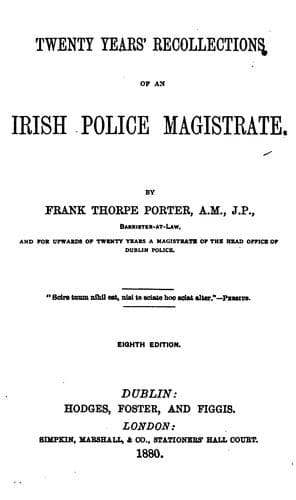
Twenty Years' Recollections of an Irish Police MagistratePorter, Frank Thorpe
History
Twenty Years' Recollections of an Irish Police Magistrate
Porter, Frank Thorpe
Crime -- Ireland; Criminals -- Ireland; Ireland -- Social life and customs; Porter, Frank Thorpe, 1801-1882
In the case to which I have last adverted, and in some others which came
under my observation, I attribute the failure of justice to the
ignorance and consequent incapacity of members of the police force or of
the constabulary engaged. However, I consider it only just to remark on
the paucity of instruction afforded to constables for detective
purposes. Activity of body, corporeal strength, general mental
intelligence, and moderate educational acquirements, are considered
sufficient qualifications for the discharge of detective duties, and
further teaching is left to be acquired by future experience. In several
continental states, reports of important criminal trials are arranged
for the use of the police by an _archiviste_, and instruction is thereby
afforded as to the means by which guilt was established, or, perhaps, to
the mistakes or rash precipitancy by which justice was defeated, or
innocence accused. The essential difference between our police and that
which I have observed in France, Belgium, and Rhenish Prussia, is
exhibited in the speedy arrests of suspected persons here, compared with
the tardiness of apprehension in the latter countries, unless the
prisoner is actually caught _in flagrante delicto_. The moment that a
suspicion is entertained in Ireland, the supposed delinquent is seized,
and thereby all chance of obtaining evidence by his subsequent acts is
completely lost. The foreign system is to watch him night and day. This
frequently eventuates in detecting him concealing property, weapons, or
bloodstained clothes, or suddenly quitting his abode without any
previous intimation, and perhaps under an assumed name. If we are to
have an efficient police, we will find it indispensably necessary to
keep well-informed, shrewd, patient, watchful detectives. I have known
many who contended that a constable should adopt no disguise, but that,
in the uniform of the force to which he belongs, he should perambulate
the streets, suppress disorders, apprehend offenders, and when directed
to execute warrants, he should go in search of the culprit openly and
avowedly. To such I would suggest, that if in the organization of a
police there is anything unconstitutional, it is rather to be found in
the adoption of a uniform than in the attire of "plain clothes." The old
common-law constable had no uniform; he went, and came, and mixed
amongst other men, without a number on his collar or a crown on his
buttons, and still his office and its functions were not denounced as
unconstitutional. A policeman in uniform may patrol our streets,
suppress riots, restrain indecency, and apprehend the pickpocket or
drunkard; but it is not by such that the progress of the swindler is to
be traced and stopped, the haunts of the burglar ascertained, or that
the minute circumstances, trifling to the casual observer, but
amounting, in the aggregate, to perfect conviction, are to be discovered
and concatenated to establish the fearful guilt of the murderer.
Public-domain text, read in full here on John Shaqi.
Reviews
Reviews
No reviews yet
Be the first to share your thoughts on this work.
Elsewhere in the archive
Join the Discussion
Join the discussion
Sign in to leave a comment or review.
Sign InorCreate an account