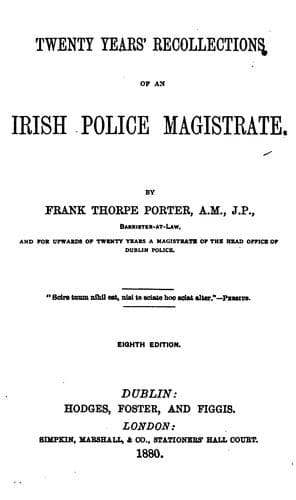
Twenty Years' Recollections of an Irish Police MagistratePorter, Frank Thorpe
History
Twenty Years' Recollections of an Irish Police Magistrate
Porter, Frank Thorpe
Crime -- Ireland; Criminals -- Ireland; Ireland -- Social life and customs; Porter, Frank Thorpe, 1801-1882
fate was intended to precede a similar termination to his own existence.
BAXTER AND BARNES.
The carriage complaints were usually disposed of at the Head Police
Office in a court upon the ground floor. The light was derived from
windows opening on a yard, and they were so near to the magisterial
bench as to enable its occupant frequently to hear observations and
conversations of an extraordinary nature. It was my custom to remain
after the carriage cases were heard, and when the criminal charges or
summonses were, in the upper court, brought before some of my
colleagues. I was thus enabled, in comparative quietude, to prepare
reports on memorials referred by the executive or revenue authorities,
or perhaps, to enjoy an occasional leisure hour over a magazine or
newspaper. When the upper court was crowded, persons would betake
themselves to the yard and frequently engage in conversation close to
the windows, which in warm weather were generally open; but there was
no indication to those outside of the presence inside of a listener to
their communications. In the summer of 1854, I was sitting alone, and
reading the latest news from the Crimea, when two women took their stand
outside the open window, and one of them proceeded to impart her sorrows
to her sympathizing friend. At the time to which I refer, recruiting was
very rife in Dublin, and it was not uncommon for us to attest one
hundred persons in a week. The utmost vigilance was exercised to prevent
or detect desertion, and in the apprehension of deserters, a police
sergeant named Barnes had particularly exerted himself, and had
consequently received rewards to a considerable amount. This was the
reason why his name was introduced into the narrative which I happened
to overhear, and which I inscribed on a blank leaf of an interleaved
statute. There is not one original idea of mine in the production, and I
should not submit it to my readers if I did not consider it essential to
the appreciation of the criticism subsequently pronounced by Mr. Barnes.
Musha! Katey Doyle, do you know what?
Shure Jem has took the shilling,
And off he's gone to Aldershot,
It's there he'll get the drilling.
The polis now along the Coombe[6]
No more will be resisted,
And Fordham's Alley's all in gloom
Since Jem has took and listed.
So have you got a dhrop at all?
My sperrits is so sinking,
I do not think I'd stop at all
If wanst I take to drinking.
The night afore he wint to list
I cribb'd his half week's wages,
And when the two 'r three hogs[7] he miss'd
At wanst he wint outrageous.
Next mornin' to the Linen Hall
He goes and takes the bounty;
It would not be so bad at all
If he had join'd the County;
For they're not gone to foreign parts,
And won't encounter dangers,
But, just as if to break our hearts,
He join'd the Connaught Rangers.
Public-domain text, read in full here on John Shaqi.
Reviews
Reviews
No reviews yet
Be the first to share your thoughts on this work.
Elsewhere in the archive
Join the Discussion
Join the discussion
Sign in to leave a comment or review.
Sign InorCreate an account