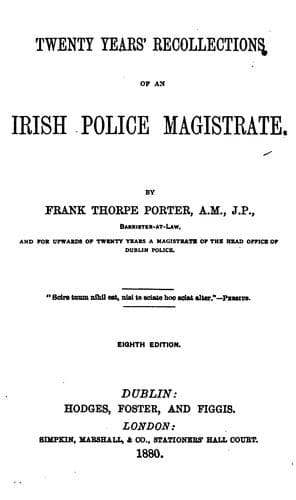
Twenty Years' Recollections of an Irish Police MagistratePorter, Frank Thorpe
History
Twenty Years' Recollections of an Irish Police Magistrate
Porter, Frank Thorpe
Crime -- Ireland; Criminals -- Ireland; Ireland -- Social life and customs; Porter, Frank Thorpe, 1801-1882
entered his house for the purpose of killing him, but their diabolical
design was thwarted by the circumstance of their intended victim being
in custody of the Dublin Police, upon an unfounded, but certainly not an
unfortunate accusation. His family had communicated with the
constabulary, lest the intended assassination might be perpetrated on
his journey home, and early on Monday morning his wife started in search
of him with the result which has been stated.
CROWN WITNESSES.
For several years subsequent to my appointment to magisterial office,
there were two houses in Great Ship Street, on the side now entirely
occupied by the barrack, which were appropriated to the accommodation of
crown witnesses. There was an internal communication between those
houses, and the witnesses, of both sexes, were allowed to associate free
from all supervision, except what served to keep them from leaving the
premises, unless accompanied by an attendant, and examining letters
received or despatched by them. Their meals were generally taken
together; and for the amusement or employment of their evenings, they
were left entirely to themselves. Amongst those witnesses almost every
variety of character was to be found. A young man, whose name has lapsed
from my recollection, was charged by a female with attempting to commit
an offence which I need not particularise, and I was directed to
investigate the affair at the premises, without imparting to it any
avoidable publicity. The accused party denied the misconduct imputed to
him, and attributed the charge to spite and resentment on the part of
the complainant and another inmate of the place. A woman stated that
"the girl was vexed by the questions put to her, and the faults found
with her evidence every time that her case was tried." I was greatly
surprised to find that the crown witnesses were accustomed to have their
evidence rehearsed before an amateur judge, an improvised jury, and a
couple of supposed counsel, one to prosecute and the other to defend. If
a case failed, the witnesses were instructed as to their deficiencies,
either in manner or matter; and they were drilled to avoid admissions of
any nature calculated to weaken their testimony. I made such
representations to the Executive as produced the suppression of the Ship
Street establishments.
WHO BLEW UP KING WILLIAM?
Public-domain text, read in full here on John Shaqi.
Reviews
Reviews
No reviews yet
Be the first to share your thoughts on this work.
Elsewhere in the archive
Join the Discussion
Join the discussion
Sign in to leave a comment or review.
Sign InorCreate an account