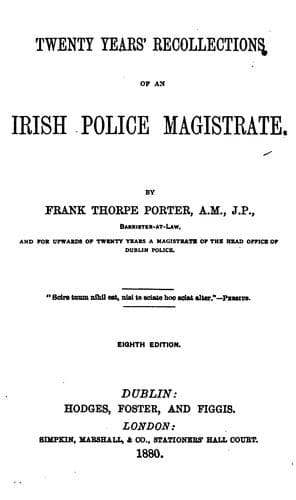
Twenty Years' Recollections of an Irish Police MagistratePorter, Frank Thorpe
History
Twenty Years' Recollections of an Irish Police Magistrate
Porter, Frank Thorpe
Crime -- Ireland; Criminals -- Ireland; Ireland -- Social life and customs; Porter, Frank Thorpe, 1801-1882
In 1844 there was the most intense excitement amongst all classes,
sects, and parties of the Irish community, arising from the prosecutions
instituted by the Attorney-General, Thomas Berry Cusack Smith against
O'Connell and several others for various alleged violations of the laws
in their meetings, publications and other proceedings adopted by them to
promote a repeal of the Union. The preliminary informations were sworn
before a judge, and none of the police magistrates were called upon to
interfere, in any way whatever, from the commencement to the conclusion
of the affair. On the 30th of May, the accused were sentenced to certain
terms of imprisonments and fines, and they were liberated on the
reversal of the judgment by the House of Lords, on the 6th September. A
few days before the sentence was pronounced, I dined in company with Mr.
John O'Connell, when he stated that they expected to be sent to Newgate
or Kilmainham, I advised him to have a special application made to the
court to order the imprisonment in the Richmond Bridewell, which was
cleanly and spacious, and where they might have access to two extensive
gardens. My suggestion was adopted, and the prisoners were sent by a
circuitous route, avoiding the great thoroughfares of the city, to the
bridewell. In the evening I was going home to my residence in Rathmines,
when I overheard a woman loudly expressing to a number of sympathetic
listeners, her hearty detestation and curse upon all "who had any hand
in sending the Liberator to the same place as that to which Porter sends
_his blackguards_."
Thomas Berry Cusack Smith, the Attorney-General, had been nicknamed,
"Alphabet Smith," from the multiplicity of his names, and when the
judgment of the Queen's Bench was reversed, a ballad appeared to the
tune of "The Shan van vocht." A police inspector asked my opinion as to
the prevention of it being chanted by the street vocalists, and I
advised him against making it more known and more relished by the
multitude, as it would be by his interference. It is as follows:--
"Musha, Dan, who let you out?
Says the T. B. C.
For you're here beyant a doubt,
Says the T. B. C.
Sure I thought I locked you in,
You contrariest of min,
And what brings you here agin?
Says the T. B. C.
Through the chimney did you climb?
Says the T. B. C.
For you're up to any crime,
Says the T. B. C.
There were locks both great and small,
Did you dare to pick them all?
Did you scale the prison wall?
Says the T. B. C.
No, I didn't scale the wall,
Says the Dan van vocht,
Through the flues I didn't crawl,
Says the Dan van vocht,
Not a weapon did I take,
And no lock I tried to break,
Such attempts I'd scorn to make,
Says the Dan van vocht.
Public-domain text, read in full here on John Shaqi.
Reviews
Reviews
No reviews yet
Be the first to share your thoughts on this work.
Elsewhere in the archive
Join the Discussion
Join the discussion
Sign in to leave a comment or review.
Sign InorCreate an account