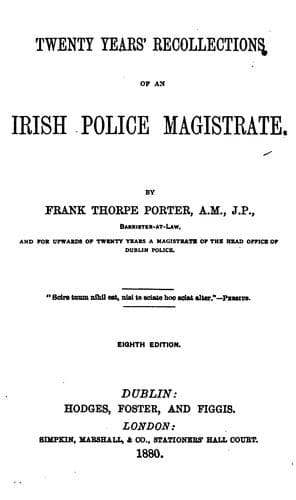
Twenty Years' Recollections of an Irish Police MagistratePorter, Frank Thorpe
History
Twenty Years' Recollections of an Irish Police Magistrate
Porter, Frank Thorpe
Crime -- Ireland; Criminals -- Ireland; Ireland -- Social life and customs; Porter, Frank Thorpe, 1801-1882
Whenever I had an opportunity to hear him, whether on legal or
political occasions, I availed myself of it, in the anticipation of
being highly amused, and I was scarcely ever disappointed. I am tempted
to detail two or three of my recollections, which have not been noticed
by any of his biographers. I am aware that my expressions must be far
inferior to his diction, but my readers will not, I hope, be too severe
in criticising my inefficiency.
I was present at the trial of a very beautiful young lady who, with her
mother and two other persons, was indicted for conspiring to take away a
minor from his parents, and have him married to the young lady in
Scotland. The prosecution was conducted with considerable acrimony, and
the Gretna-Green bride was described as a person of very tarnished
reputation, whose favorite paramour had been a _blacksmith_. No proofs
were adduced of the imputed immorality, and O'Connell, in a speech for
the defence, denounced it as a fabrication "which had not even the merit
of originality, but was borrowed from the mythological assignment of
_Vulcan to Venus_."
At the commencement of the first viceroyalty of the Marquis Wellesley, a
newspaper was started in Parliament Street by a Mr. Hayden. It was
called _The Morning Star_, and its editorial articles were almost
exclusively devoted to the most disparaging and insulting productions in
reference to the Lord Lieutenant or O'Connell. The latter was never
forgotten; and every term of obloquy was put in requisition for his
diurnal vilification. Firebrand, Rebel, Arch-mendicant, Liar, Impostor,
Schemer, were liberally appropriated to him, and even the shape of his
hat, and the mode of carrying his umbrella, became subjects of offensive
observation. The attention of the Attorney-General was attracted to an
article in _The Morning Star_, headed "The profligate Lord Wharton," the
writer of which stated that the history of the Wharton viceroyalty had
never been fully published, because a true description of such a
character would be considered as an incredible exaggeration, but that it
might now be produced without any apprehension of such an opinion
prevailing, inasmuch as its worst details would be found fully equalled
in Dublin Castle under the auspices of its present occupant. A criminal
information was filed against Mr. Hayden for a libel on the Lord
Lieutenant; and he became extremely apprehensive of a severe punishment,
resulting from his very offensive comparison of Lord Wellesley with Lord
Wharton. He immediately engaged William Ford as his attorney, and the
next step was to retain O'Connell as his principal counsel. The latter
agreed to act, but required that he should be left completely free to
adopt whatever line of defence he preferred, and to manage the case at
his own discretion. The trial was held in the King's Bench before Bushe,
the Chief Justice, and the opening statement for the prosecution was
delivered by the Attorney-General, Plunket.
Public-domain text, read in full here on John Shaqi.
Reviews
Reviews
No reviews yet
Be the first to share your thoughts on this work.
Elsewhere in the archive
Join the Discussion
Join the discussion
Sign in to leave a comment or review.
Sign InorCreate an account