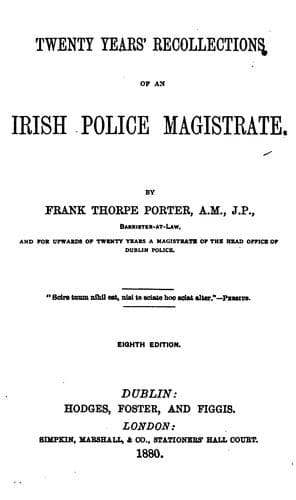
Twenty Years' Recollections of an Irish Police MagistratePorter, Frank Thorpe
History
Twenty Years' Recollections of an Irish Police Magistrate
Porter, Frank Thorpe
Crime -- Ireland; Criminals -- Ireland; Ireland -- Social life and customs; Porter, Frank Thorpe, 1801-1882
In 1834, the question of Repeal of the Union was introduced by O'Connell
to the House of Commons, and negatived by an overwhelming majority. The
principal opponent of the motion was Thomas Spring Rice (afterwards Lord
Monteagle) who was then one of the members for Limerick city, and a very
general opinion was immediately entertained that he would never be
elected there on any future occasion. In the autumn of 1834, I was
appointed a revising barrister in reference to tithes, and in that
capacity I visited Limerick. I had finished my business, and was
preparing for my departure, when about two o'clock in the afternoon,
O'Connell arrived at the hotel (which was, I think, Cruise's), and the
street was immediately thronged to excess by an enthusiastic multitude.
He was on his way to Dublin; but whether he wished to address the
people or not, it was manifest that a speech from the balcony was
unavoidable. I got as near to him as the crowded state of the apartment
permitted, and was enabled to hear his oration fully; but of course I
cannot do more than give its general import, and endeavour to describe
its effect. He commenced by stating that a report had been circulated
that he intended to interfere with the people of Limerick, and to
direct, and even _to dictate_, the choice of their Parliamentary
representatives. This rumour he denounced as a scandalous, infamous
_lie_. He had no wish to curb or trammel them in the exercise of their
rights, and he was not such a fool as to attempt dictation to a
community too independent and intelligent to yield to any influence
except dispassionate arguments suggested by patriotism and conducive to
the welfare of their beloved country. Frequent and rapturous cheers from
listening thousands evinced their appreciation of his address,
especially when he referred to the valorous defence of their city by
their forefathers. At length he said that his topics were exhausted, and
that he had nothing to add unless they wished him to tell them a _little
story_. Shouts were immediately raised for "the story, the story," and
he proceeded to narrate that about the beginning of the present century
an opinion was very prevalent that the French intended to invade
Ireland, and it was considered probable that their fleet would enter the
Shannon, and land the troops on the left side of that splendid river, in
the vicinity of Limerick. The French had exacted such heavy
contributions from the continental states which they had occupied, that
very great apprehensions were entertained that their invasion of Ireland
would be attended with similar results, and that the industrial
resources of the country and the savings of the people would be speedily
spoliated. There then lived near Foynes a farmer named Maurice Sullivan,
a man of excellent character, religious, sober, thrifty, industrious,
and intelligent. He had a loved and loving wife, comely and amiable, who
made his home happy by the observance of every domestic duty. On a
Public-domain text, read in full here on John Shaqi.
Reviews
Reviews
No reviews yet
Be the first to share your thoughts on this work.
Elsewhere in the archive
Join the Discussion
Join the discussion
Sign in to leave a comment or review.
Sign InorCreate an account