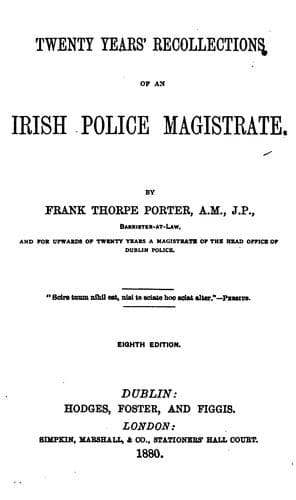
Twenty Years' Recollections of an Irish Police MagistratePorter, Frank Thorpe
History
Twenty Years' Recollections of an Irish Police Magistrate
Porter, Frank Thorpe
Crime -- Ireland; Criminals -- Ireland; Ireland -- Social life and customs; Porter, Frank Thorpe, 1801-1882
No more offensive epithet can be applied in this country, in the warmest
spirit of invective, than that of an "informer." I have repeatedly
heard it asserted as a popular maxim, that all informers should be shot.
I can truly and deliberately declare it to be my firm conviction, that
if all the informers of 1848 were so disposed of, the Confederate clubs
and revolutionary associations of Dublin would have been decimated.
There were in one great commercial establishment _forty_ Confederates,
of whom _ten_ were in communication with the police. I resided at
Roundtown, and I would often have preferred walking into town or
strolling homeward, when I had to take a seat on a hackney car or in an
omnibus to avoid a request to step into Blackberry Lane or turn up the
Barrack Avenue, and listen to details of proceedings of which it is
highly probable I had been already fully apprised.
A smith, in a town between thirty and forty miles from Dublin, was
engaged to manufacture pikes. He made two hundred and eighty pike-heads,
and brought them, according to directions which he had received, to a
place, the designation of which was peculiarly appropriate for the
reception of such articles, for it was the _slaughter-house of a
butcher_. They were of the best quality, in respect of materials and
workmanship. The industrious tradesman delivered the "goods" to his
customer, and was paid fully and promptly. He then made me acquainted
with the transaction, and I referred him to the Commissioners of Police.
They entrusted its management, or perhaps I might more correctly say its
mismanagement, to a superintendent who, instead of having the premises
closely watched, proceeded precipitately to seize the weapons. They were
packed in strong deal cases, of the contents of which the butcher and
his assistants declared that they had no knowledge. Before the Executive
came to any conclusion as to what course was to be adopted, the hopes of
the revolutionists had been extinguished at Ballingarry. No prosecution
was instituted, and the pike-heads were sent to England where, I
believe, they were transferred to the naval department.
THE CLOSE OF 1848.
Public-domain text, read in full here on John Shaqi.
Reviews
Reviews
No reviews yet
Be the first to share your thoughts on this work.
Elsewhere in the archive
Join the Discussion
Join the discussion
Sign in to leave a comment or review.
Sign InorCreate an account