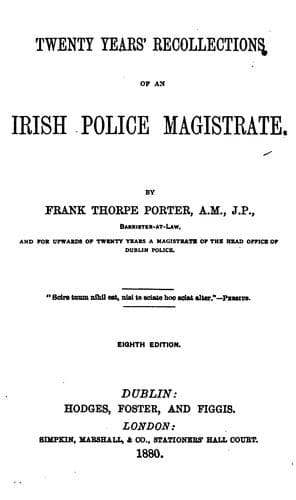
Twenty Years' Recollections of an Irish Police MagistratePorter, Frank Thorpe
History
Twenty Years' Recollections of an Irish Police Magistrate
Porter, Frank Thorpe
Crime -- Ireland; Criminals -- Ireland; Ireland -- Social life and customs; Porter, Frank Thorpe, 1801-1882
During the first six or seven months of 1848, the superior officers of
regiments in Dublin made frequent communications respecting the
assiduous exertions of the disaffected to sap the loyalty of the
soldiery, and effect an introduction of the military element to their
fraternity. Much time and money were applied to this purpose; but,
although the sobriety of the soldier was frequently impaired, his
loyalty remained intact, and his usual apology for an unsteady step, or
for returning late to his quarters, ascribed the fault to "the bloody
rebels." "They had made him drink a great lot of bad toasts, and he
wouldn't have done so for them, if the whiskey had not been very good."
The only instance of disaffection found to exist in a military body was
amongst the Royal Artillery at Portobello barrack. An Irishman who had
enlisted in London, in 1846, under a false name, induced thirteen of his
comrades to join him in forming a Confederate association. Their usual
place of meeting was very near to my residence at Roundtown; and the
first information which I received concerning them arose from the
resentment of a woman. I had some communication with Colonel Gordon, the
Adjutant-general of the Ordnance, and we were both inclined to
disbelieve the statement which I had received. Eventually, however, we
became satisfied of its truth, and acquired such additional evidence as
to render the case sufficiently strong to procure a conviction of all
the delinquents by a court-martial. I earnestly advised Colonel Gordon
to leave them unprosecuted, but to disperse them. He adopted my views,
and in a few days not one of the fourteen was in Ireland, neither were
any two sent to the same station. In 1861, I saw the principal offender
at Gibraltar. He was then a sergeant.
The abortive attempt at revolution in 1848 was decidedly obstructive to
the progress of all the industrial pursuits which conduce to the
prosperity of a country and the comforts of a community. It also
involved the expenditure of vast sums in maintaining military forces,
augmented police and constabulary, and defraying the expenses of special
commissions. There is only one agreeable recollection afforded by it.
Neither side shed blood. Popular violence inflicted no mortal injury,
and no victim was demanded by the ultimate restoration of Law and Order.
I am now disposed to lay before my readers a short extract from a French
author (Le Comte de Melun), in reference to insurrectionary movements.
It is from his "Life of Sister Rosalie, the Superioress of the Order of
Charity." A work crowned by the French Academy.
Public-domain text, read in full here on John Shaqi.
Reviews
Reviews
No reviews yet
Be the first to share your thoughts on this work.
Elsewhere in the archive
Join the Discussion
Join the discussion
Sign in to leave a comment or review.
Sign InorCreate an account