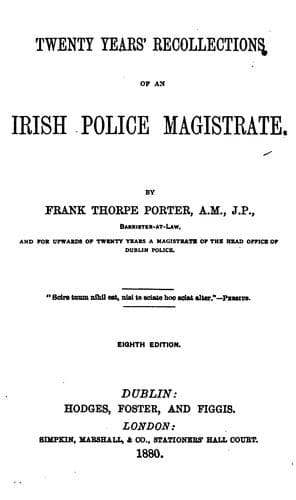
Twenty Years' Recollections of an Irish Police MagistratePorter, Frank Thorpe
History
Twenty Years' Recollections of an Irish Police Magistrate
Porter, Frank Thorpe
Crime -- Ireland; Criminals -- Ireland; Ireland -- Social life and customs; Porter, Frank Thorpe, 1801-1882
In 1849, when it became known that Queen Victoria would visit Dublin, a
great influx of the nobility and gentry was reasonably expected. The
city became also very attractive to persons of a different and
objectionable description. Great numbers of mendicants arrived, and the
increase of beggars on our streets became most disagreeably apparent.
The Commissioners of Police immediately told off constables in plain
clothes on the special duty of repressing the nuisance, and so vigilant
and active were they, that our thoroughfares were less infested by
beggars during the Royal visit than I ever knew them to be at any other
period. The committals were generally for ten or fourteen days; and many
of the vagrants were by no means slow in attributing their confinement
to special orders from the Queen herself to have the beggars locked up
while she was in Dublin. A woman, who was committed by me for a
fortnight on a conviction for mendicancy, exclaimed, as she was leaving
the police-court, "Mr. Porter is sending us to jail in hopes of getting
himself made Sir Frank."
During the Queen's progress through the city on the 6th of August, the
whole line of the procession was densely crowded, the windows were
occupied, and banners, emblematic of respect and welcome, abundantly
displayed; and she was universally hailed with enthusiastic shouts of
applause. In the evening there was a general and most brilliant
illumination. The whole day passed without the slightest tumult or
accident, until about eleven o'clock at night, when the vast crowds were
dispersed by the heaviest rain that I ever witnessed in Ireland. The
shower lasted about an hour. During the succeeding four days, Her
Majesty visited the principal public institutions, and held a levee in
Dublin Castle, the most numerous and influential that had ever been
assembled there, and a drawing-room which exhibited an unprecedented
display of rank, fashion, and beauty. On the 10th of August, she
embarked at Kingstown, amidst the acclamations of assembled thousands,
and sailed for England. She afforded signal acknowledgments of her
appreciation of the reception she had experienced from her Irish
subjects, for on leaving the pier at Kingstown, she ordered the Royal
standard to be lowered and raised again on board the Royal yacht, a mark
of honor never before employed except for a Royal personage. In a short
time after her visit of 1849, she created her eldest son Earl of Dublin.
SCOTCH SUPERIORITY STRONGLY ASSERTED.
Public-domain text, read in full here on John Shaqi.
Reviews
Reviews
No reviews yet
Be the first to share your thoughts on this work.
Elsewhere in the archive
Join the Discussion
Join the discussion
Sign in to leave a comment or review.
Sign InorCreate an account