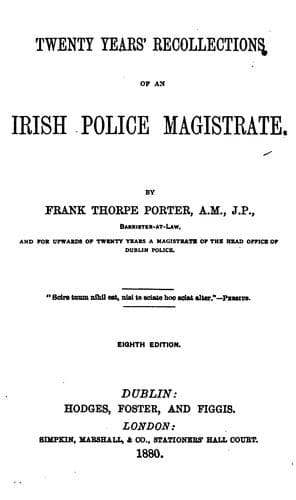
Twenty Years' Recollections of an Irish Police MagistratePorter, Frank Thorpe
History
Twenty Years' Recollections of an Irish Police Magistrate
Porter, Frank Thorpe
Crime -- Ireland; Criminals -- Ireland; Ireland -- Social life and customs; Porter, Frank Thorpe, 1801-1882
But in reference to this most extraordinary culprit, it remains to be
mentioned that the police discovered and proved before the _Cour
d'assises de la Seine_, on the 10th July, 1819, that Coignard, even
after he had attained to rank and opulence, was in communication with
several of the most accomplished robbers of Paris, and that he aided
them by using the opportunities derived from his intimacy with persons
of wealth and proprietors of costly mansions, to ascertain where their
money and plate were kept, and at what time the property might be
pillaged with the least risk of interruption or detection. When he found
the proofs of his past and of his continued delinquencies accumulated
beyond any possibility of resisting an adverse judgment, he attempted to
escape, and on being arrested, he discharged several pistol shots at the
police officers, by which two of them were dangerously wounded and
permanently disabled. Amongst the associates of his aristocratic career,
there was far less indignation expressed at his robberies or dishonest
proclivities, than at his audacious assumption of exalted rank, and his
intrusion amongst a class, the members of which would evince greater
lenity to the opening of a banker's coffers by means of false keys, than
to the attainment of admission to a courtly circle by a pretended title
of nobility. Conclusive evidence having been adduced of the identity of
Coignard as an escaped convict, and also of his subsequent complicity in
several criminal transactions, he was remitted to Toulon, there to be
imprisoned for life and kept to hard labor. When he left the Bicetre, on
the 24th July, 1819, on the galley chain, an enormous crowd assembled to
witness his departure, and his demeanour was remarked as indicating
neither despondency nor contrition. In the towns through which he
passed, he excited the utmost curiosity. The false Comtesse, Maria Rosa,
proceeded to Toulon, and subsisting on whatever she had been able to
save from the wreck of her previous fortunes, she continued firmly
attached to the wretched Coignard. She visited him whenever permitted,
and afforded him every attention that the rules of the prison allowed.
She died in 1829, and he survived her only until the succeeding spring.
I think that in laying before my readers the details of this romantic
reality, I have given them an instance of fact being far more
extraordinary than fiction. The materials in the narrative last related,
are not suitable for being woven into one piece in the loom of fiction.
Those who would make a Count the hero or principal character of an
imaginative production, would shrink from choosing him amongst the
galley slaves of Toulon. Those who would make a convict a prominent
actor in any ideal drama, would consider it too ridiculous to dignify
him with a title immediately after his escape from penal servitude.
Public-domain text, read in full here on John Shaqi.
Reviews
Reviews
No reviews yet
Be the first to share your thoughts on this work.
Elsewhere in the archive
Join the Discussion
Join the discussion
Sign in to leave a comment or review.
Sign InorCreate an account