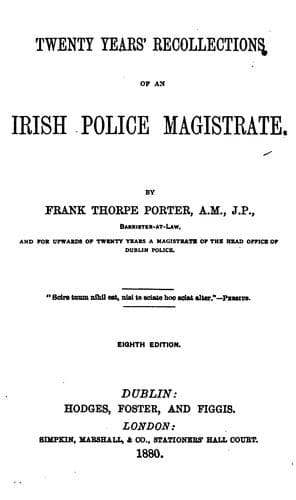
Twenty Years' Recollections of an Irish Police MagistratePorter, Frank Thorpe
History
Twenty Years' Recollections of an Irish Police Magistrate
Porter, Frank Thorpe
Crime -- Ireland; Criminals -- Ireland; Ireland -- Social life and customs; Porter, Frank Thorpe, 1801-1882
Constrained to yield to this specious resistance, Mademoiselle de
Pal---- retired to her chamber, and there wrote to her father an account
of all that had passed, and urged the imperative necessity of
immediately flying from the gallantry of the King. The poor child
comforted herself in the expectation of a prompt succour from her
father. What would have been her feelings if she had witnessed the
transports of joy in which the old gentleman indulged at the apparent
certainty of accomplishing his designs? It was a complete delirium!
Repeatedly he embraced the Chevalier d'Arc, whose pockets he replenished
with money. Then taking his pen, he hastened to reply that it appeared
premature to impute evil designs to any person; that the King could have
no bad intentions. Finally, they owed his Majesty so much love and
respect, that all other feelings should be absorbed in reference to him.
The conclusion of this letter plunged the virtuous girl in despair.
After two more days, she received a second visit from the King, and was
offered homage of a more marked character--the most costly stuffs, and
various other articles of such enormous value as could not be authorized
by simple gallantry or innocent admiration. Mademoiselle de Pal----,
distracted, overwhelmed, saw herself abandoned by those on whom the very
feelings of nature should have imposed the duty of protecting her
innocence. She did not accuse her father directly, but her mind was
beset with frightful suspicions.
One morning, at an early hour, the Marchioness not having left her
bed-chamber, a girl, who filled some very subordinate station in the
establishment, came into the apartment of Mademoiselle, in the absence
of the _femme-de-chambre_ who had been assigned to her. This damsel,
entering cautiously, informed Helene that a handsome lad, in her
father's livery, had brought a letter which he would deliver only to
herself in person.
Too much tormented not to distinguish any favorable circumstance in her
unhappy situation--knowing, moreover, that her father had not permitted
his two old servants to bring his family livery to Paris--she was only
too ready to take advantage of the opportunity afforded by the early
hour; consequently, she consented to receive the envoy.
Public-domain text, read in full here on John Shaqi.
Reviews
Reviews
No reviews yet
Be the first to share your thoughts on this work.
Elsewhere in the archive
Join the Discussion
Join the discussion
Sign in to leave a comment or review.
Sign InorCreate an account