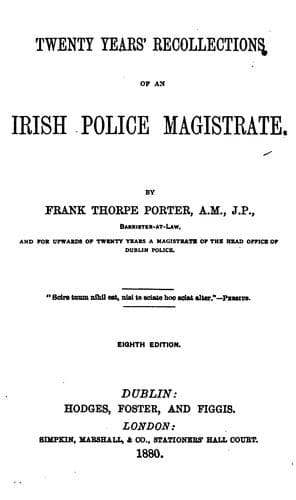
Twenty Years' Recollections of an Irish Police MagistratePorter, Frank Thorpe
History
Twenty Years' Recollections of an Irish Police Magistrate
Porter, Frank Thorpe
Crime -- Ireland; Criminals -- Ireland; Ireland -- Social life and customs; Porter, Frank Thorpe, 1801-1882
In the morning she requested an audience of _Madame_, which was
immediately granted, and she earnestly implored of her not to report
what had passed to his Majesty. "I know not what I might do on another
occasion," was the reply, "but in the present case I have only to
express my regret that the King is already fully informed upon the
subject."
"It will be upon me then," promptly observed Helene, "that his wrath
must fall, since my generous defender is dead."
"Dead! the Vicomte de Benavent-Rhodés! You are pleased to think so,"
remarked this depraved woman, in a bantering tone. "Certainly it is not
owing to him and his associates that some of the King's servants did not
perish. Happily, there has been more noise than actual injury; but this
gentleman and four other musketeers are in the custody of the
grand-prevot, and they must answer to justice for an armed attack, at
midnight, on a royal residence. The laws of France attach capital
punishment to such an outrage."
Mademoiselle de Pal---- uttered a piercing shriek, and fell into violent
convulsions, which excited great alarm in the mind of _Madame_, lest the
death, or even the severe indisposition, of the young beauty, should be
imputed to her indiscretion. She sought to assuage her sufferings, and
when restoratives had produced relief, strongly advised her to apply to
his Majesty, who was of a merciful disposition, and would not refuse
pardon to the musketeers at her intercession.
The dread of the price which would be demanded for this favor
contributed to diminish the pleasure which the hope of clemency excited.
Nevertheless she resolved to meet the peril, trusting to overcome it,
and to conquer culpable intentions by purity of heart and the innate
power of virtue. When she ascertained that Louis XV had arrived, she
proceeded to the saloon. The conversation was gay, brilliant, and
varied. Mademoiselle displayed the intrepidity which is so frequently
the attendant of innocence, and although her face was suffused with
blushes, her voice was distinct and unfaltering, as she gracefully and
respectfully besought the King to pardon the five prisoners. Louis
reverted to his feelings towards herself, and observed that it lay in
her power to induce him to interfere in a matter which involved a
direct offence against his personal safety and his rights. He indulged
in the chivalrous levity which has so often characterised the Bourbons,
remarking that he was her slave, but that even a slave should not be
exasperated. Finally, he gave her distinctly to understand that the fate
of the prisoners depended on her compliance.
She demanded four days' interval, which the King acceded to, adding that
she could not follow a better example than that of Jephtha's daughter.
Two days had elapsed, the King was going to Mass, when a priest placed
himself in front of the cortege.
"Monsieur l'Abbé," said the Duc de Richelieu, "stand aside, you impede
his Majesty's passage."
Public-domain text, read in full here on John Shaqi.
Reviews
Reviews
No reviews yet
Be the first to share your thoughts on this work.
Elsewhere in the archive
Join the Discussion
Join the discussion
Sign in to leave a comment or review.
Sign InorCreate an account