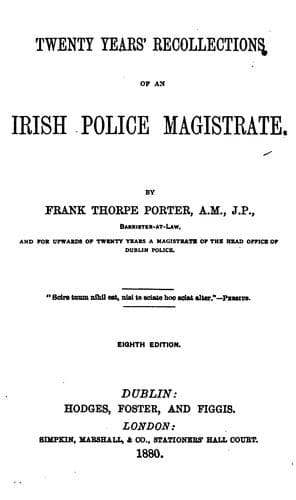
Twenty Years' Recollections of an Irish Police MagistratePorter, Frank Thorpe
History
Twenty Years' Recollections of an Irish Police Magistrate
Porter, Frank Thorpe
Crime -- Ireland; Criminals -- Ireland; Ireland -- Social life and customs; Porter, Frank Thorpe, 1801-1882
All, through a motive of amusement, even those who were not desirous of
making a personal experience of her imaginative power, surrounded the
fortune-teller. When it came to the turn of the young Count de Coucy to
extend his palm, he offered it. The old hag examined his hand for a much
longer time than she had devoted to the inspection of the preceding
ones, and suddenly rejecting it with every indication of disdain, she
exclaimed--"Back, fellow! Begone, clown! I am here to speak only to
gentle-folk, and not to tell the future destiny of a peasant's son."
At these words there was a universal laugh: some ridiculing the old
woman on her divining power, others venting a good-humoured raillery
upon their companion. He knew not whether to be jocular or angry. They
informed the old woman of the name and title of the illustrious youth
whom she had designated the son of a peasant, but she continued to swear
by all the saints that the young Coucy was nothing else. The uproar
occasioned by this denunciation continued to such a pitch, that the
captain of cavalry, the commandant of the academy, interfered, and
calling a groom, directed him to turn out that woman.
"That a woman!" exclaimed the groom; "I would wager that it is a man."
Another groom declared that he had seen an individual, in the habit of a
peasant, enter a neighbouring tavern, from whence, in about a quarter of
an hour, he had issued disguised as a female; and he averred that the
fortune-teller whom they had just expelled was the same person. The
young Count de Coucy heard these statements with indifference; but as
they referred to a creature who had seemed to take pleasure in insulting
him, they did not entirely lapse from his recollection.
Six months passed. One morning the Marquis de Coucy, being in his room,
was discussing with the Marchioness a project of marriage for the young
Count; they were anxious to marry him to a princess of the house of
Lorraine. In the midst of their deliberations, a valet-de-chambre
appeared. He was the brother of the young Count's foster-father, and the
servant to whom the Marquis manifested the greatest liking and
confidence. He apologised for disturbing their conversation, and stated
that a young man, of a most elegant demeanor and prepossessing manner,
and whose appearance seemed almost familiar to him, requested to be
admitted.
"Let him come in," said the Marquis. The stranger is introduced. He is
youthful, and appears not to have passed his seventeenth year; his
figure slight and symmetrical; his aspect expressive and bland; his
carriage is good, he has a sweet smile, and his salute is agreeable.
Still his deportment does not suggest that noble blood is coursing
through his veins. He has not the aristocratic air which a courtly life
imparts, or the polished manner derived from elevated society.
Public-domain text, read in full here on John Shaqi.
Reviews
Reviews
No reviews yet
Be the first to share your thoughts on this work.
Elsewhere in the archive
Join the Discussion
Join the discussion
Sign in to leave a comment or review.
Sign InorCreate an account