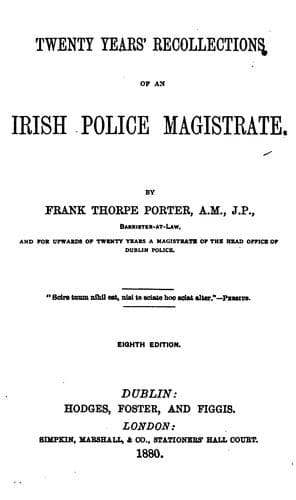
Twenty Years' Recollections of an Irish Police MagistratePorter, Frank Thorpe
History
Twenty Years' Recollections of an Irish Police Magistrate
Porter, Frank Thorpe
Crime -- Ireland; Criminals -- Ireland; Ireland -- Social life and customs; Porter, Frank Thorpe, 1801-1882
Dumas does not entirely ignore the name of Patrick O'Reilly, but he
gives it to a jeweller, whom he mentions as the wealthiest and most
skilful of all then following that trade in London. In his novel of the
Count of Monte Cristo, he introduces the hero as the chief officer of a
fine merchant ship. It would have been more true, though perhaps rather
vulgar, to have presented to his readers, a shoemaker, of the
description called chamber masters, whose name was François Picaud, and
who, through motives of jealousy or envy, was represented to Savary, duc
de Rovigo, as an agent or spy for the English and the royalists of La
Vendee. He was imprisoned, his intended marriage having been prevented
by his arrest, and continued incarcerated at Fenestrelle from 1807 to
1814. In the prison he was appropriated as a personal attendant to a
Milanese ecclesiastic, of high rank, who died in January, 1814, having
confided to Picaud full information as to his immense property, and the
places where the documents necessary to it were to be found. He also
gave him a brief testamentary grant of all he possessed or was entitled
to. There was a very great value accruing to the legatee in diamonds and
hidden coin, but that treasure was in the vicinity of Milan, and the
statements respecting the Chateau d'If, and the island of Monte Cristo,
were complete fictions.
As to the last novel to which I have adverted, I am tempted into finding
very great fault with one of its incidents, which appears most
unnatural, and therefore most improbable. I refer to the scene between
the ruined merchant and his son, in which a father acknowledges his
intention to commit suicide, and ultimately persuades his son to
acquiesce in such a crime; nay, even to use to his parent, with the
pistols lying before him prepared for the catastrophe, the expression,
"Die in peace, my father, I will live." This is, I repeat, unnatural and
improbable. The English are said to be a suicidal people, amongst whom a
November day produces throat-cutting, pistoling, and poisoning; but in
England was there ever an instance of suicide being the subject of
consultation between parent and child? Oh! never; nor do we believe that
such could appear to our continental neighbours more consistent with the
state and feelings of society amongst them than it is amongst ourselves.
A THREATENED SUICIDE.
Public-domain text, read in full here on John Shaqi.
Reviews
Reviews
No reviews yet
Be the first to share your thoughts on this work.
Elsewhere in the archive
Join the Discussion
Join the discussion
Sign in to leave a comment or review.
Sign InorCreate an account