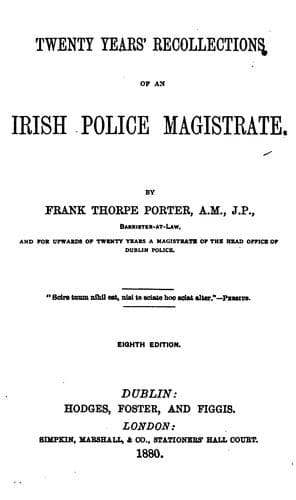
Twenty Years' Recollections of an Irish Police MagistratePorter, Frank Thorpe
History
Twenty Years' Recollections of an Irish Police Magistrate
Porter, Frank Thorpe
Crime -- Ireland; Criminals -- Ireland; Ireland -- Social life and customs; Porter, Frank Thorpe, 1801-1882
A large ship was quartered to convey the head-quarters of the 11th
hussars from Kingstown to Balaklava. A considerable number of horses
were embarked, and there were slings fastened to the roof and passing
under each animal's body, which supported him whilst sleeping, but
without allowing him to lie down. All arrangements for sailing had been
completed. A steamer was provided to tow the vessel to the outside of
the Kish Bank, and the wind was as favorable as possible for proceeding
down the Channel. The captain announced, about ten o'clock, a.m., that
he would leave at noon, whereupon three of his crew asked him to defer
his departure until the next day, and to allow them to spend the
intermediate time ashore. On his refusal, they required him to hoist a
signal, which, to the best of my recollection, was _a blue shirt_, at
the foretop, and he complied with their demand, inasmuch as, according
to his statement to me, his refusal would subject him to most severe
penal consequences. The signal denoted that there were persons on board
willing to serve in the Royal Navy; and as soon as it was displayed, a
lieutenant who was stationed at Kingstown, on the duty of naval
recruiting, went on board, and was informed by the three sailors that
they were desirous of joining his service. He acceded to their
application, and the captain found himself unable to put to sea for want
of sufficient hands, and without any expectation of being able to supply
the deficiency for some days. In this emergency, he applied to me to
have the men treated as wilful absconders, and to send them back to the
ship. I had a communication with the lieutenant, whose name, I think,
was Henderson; and whilst he fully admitted the hardship of which the
captain complained, he declared that his orders were so stringently
imperative that he could exercise no discretion, and had no alternative
course to adopt. I observed that by retaining the men there would be a
serious injury inflicted by one department of the public service on
another, and that it amounted to military exertion being paralyzed by
naval interference. He agreed with me as to the injurious effect of
having the ship detained, but declared that he was unable to prevent it.
I said that under the circumstances, I was inclined to have the men
taken and sent back to the vessel from which they had virtually
absconded. To this he replied, that he would offer no resistance to the
execution of any warrant or order that I might issue, but that he would
report the proceeding to the Admiralty. Thereupon, I suggested to the
captain to have the ship taken from alongside the jetty to the centre of
the harbour, and to stop any further communication with the shore. This
was immediately done, and I then sent a warrant for the seamen, and had
them conveyed on board, having previously advised them to go of their
own accord, which they declined doing, with the intimation that if they
Public-domain text, read in full here on John Shaqi.
Reviews
Reviews
No reviews yet
Be the first to share your thoughts on this work.
Elsewhere in the archive
Join the Discussion
Join the discussion
Sign in to leave a comment or review.
Sign InorCreate an account