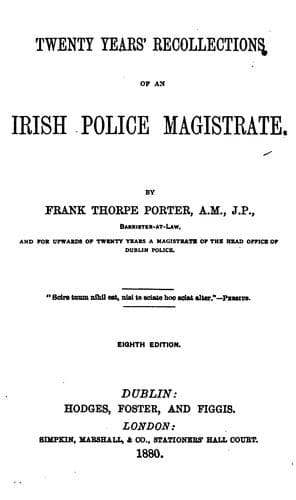
Twenty Years' Recollections of an Irish Police MagistratePorter, Frank Thorpe
History
Twenty Years' Recollections of an Irish Police Magistrate
Porter, Frank Thorpe
Crime -- Ireland; Criminals -- Ireland; Ireland -- Social life and customs; Porter, Frank Thorpe, 1801-1882
"May it please your honor, I'm only a private soldier, and where would I
get five pounds in a day or two, when they begin again. Besides, if I
was a fit bail, I would sooner be bound for his wife's behaviour than
for my own wife's. 'Tis best to let them go." Then turning to his
comrade, he added, "Come, Sam, we're likely to have a quiet month while
they're both up."
Nevertheless, he was disappointed, for the two viragoes, acting on the
suggestion of an attorney who had been engaged in the case, came almost
immediately to terms, and neither of them would make an information.
They were consequently liberated, and instead of having a quiet month, I
am sure that the artillery men had, during that time, to undergo some
heavy domestic bombardments.
THE DUBLIN GARRISON.
The regular military establishments in our district produced very few
cases for decision by the civil authorities. I am not able to state the
exact strength of the Dublin garrison, but I believe that it is the
largest in the United Kingdom, and that the seven barracks never contain
less than five thousand men of all ranks and arms. Since the
commencement of the present century, this city has had quartered within
its limits or immediate suburbs every regular regiment in the service,
and large bodies of militia. In 1813, a private dragoon named Tuite
deserted, and on a Sunday morning stopped a gentleman named Goulding on
South Circular Road, near Portobello, for the purpose of robbing him.
The offence had a fatal conclusion, for Goulding was shot through the
heart, and the murderer was apprehended and executed. After his
conviction he acknowledged his guilt, but declared that he intended only
to rob, and that the discharge of the pistol was occasioned by his
trepidation. In 1818, a corporal named Alliard was indicted for
murdering a woman named Flood, in a cellar in Thomas Street, and he was
acquitted. These two cases constituted all the capital charges preferred
against soldiers before civil tribunals in our district from 1800 to the
present time. During my magistrature of upwards of twenty years'
duration, I had to send two private soldiers for trial on a charge of
passing base coin, and one of them was convicted. I had no cognizance or
knowledge of offences purely military as to their nature or number.
Whenever a soldier was found on a public thoroughfare in a state of
intoxication, he was taken by the police, and when sober, sent by
magisterial order to the officer commanding at his quarters; but the
number of such captures was very inconsiderable. Indeed if the entire
population of the district had been strictly similar to the military in
their habits and conduct, my office would have been almost a sinecure.
AN ARTILLERY AMAZON.
Public-domain text, read in full here on John Shaqi.
Reviews
Reviews
No reviews yet
Be the first to share your thoughts on this work.
Elsewhere in the archive
Join the Discussion
Join the discussion
Sign in to leave a comment or review.
Sign InorCreate an account