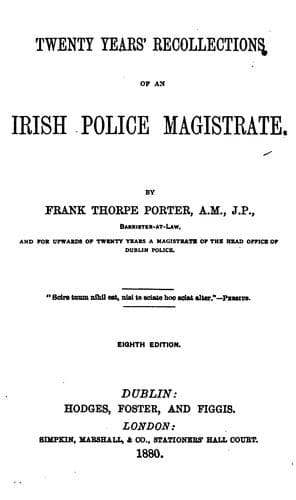
Twenty Years' Recollections of an Irish Police MagistratePorter, Frank Thorpe
History
Twenty Years' Recollections of an Irish Police Magistrate
Porter, Frank Thorpe
Crime -- Ireland; Criminals -- Ireland; Ireland -- Social life and customs; Porter, Frank Thorpe, 1801-1882
I was told, in casual conversations with artillery officers, that
one-third of the ammunition contained in the magazines of Gibraltar was
expended yearly, and that the deficiency was supplied by an equal
quantity from home. I was informed that gunpowder becomes deteriorated
if kept beyond three years, and that the most advantageous use of the
old stock was to expend it in artillery practice. Some of the floating
targets were stated to be eight hundred yards, and others six hundred,
from the battery. I saw shells used very frequently, and was informed
that the practice was not efficient or satisfactory if at least
one-third of the shells did not explode directly over the target. The
bay is occasionally visited by large shoals of porpoises, and in calm
weather they frolic in great numbers on the surface of the water. On a
day in June, 1861, they were extremely abundant, and no where more so
than close to the floating targets. Every shell discharged, killed or
disabled some of them without frightening the others or dissolving their
"aggregate meeting." Some tons of porpoises were collected after the
firing ceased, and subjected, I believe, to some process for the
extraction of oil. I was a spectator, for about two hours, of the scene
I have endeavoured to describe, and it impressed me with an awful
appreciation of our artillery as applicable to actual warfare.
DEPARTURE FOR HOME.
Early in the month of September I mentioned, in a conversation with the
naval superintendent, my intention to leave Gibraltar for England by the
first homeward-bound steamer of the Peninsular and Oriental Company that
arrived. He observed that the "St. Jean d'Acre," the flag-ship of
Admiral Elliot, was to sail for Plymouth on the 8th or 9th, and that if
I chose to go in her he would ask the Admiral to give me a passage. To
this most friendly proposal I thankfully acceded, and received, through
Captain Warden, an invitation from the Admiral, and an intimation that a
cot should be slung up for me in his saloon. At the appointed time, I
went on board, and met with a most gratifying reception from the Admiral
and the other officers. I was apprised that the ship was to call at
Tangier, and also at Cadiz, which might cause a delay of some hours at
each place. We went very quickly to Tangier, where a communication was
received for the British ambassador at Madrid, to be transmitted to him
from Cadiz. On arriving off the latter place, the Admiral landed and
came back in about an hour to have his personal luggage packed up, to
put his sailing captain in full command of the vessel, and then to
proceed himself to Madrid as speedily as possible, in accordance with a
telegraphic message from our ambassador. All requisite arrangements were
very quickly completed; but before he left the ship he addressed the
officers and crew, expressing briefly but strongly his regret at parting
from those who had evinced, whilst under his command, the greatest
Public-domain text, read in full here on John Shaqi.
Reviews
Reviews
No reviews yet
Be the first to share your thoughts on this work.
Elsewhere in the archive
Join the Discussion
Join the discussion
Sign in to leave a comment or review.
Sign InorCreate an account