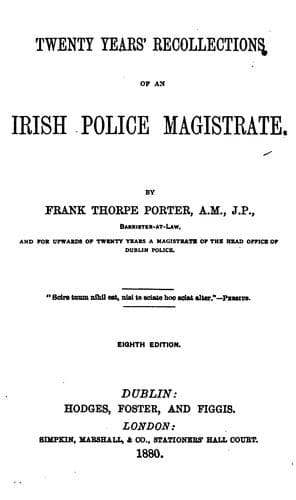
Twenty Years' Recollections of an Irish Police MagistratePorter, Frank Thorpe
History
Twenty Years' Recollections of an Irish Police Magistrate
Porter, Frank Thorpe
Crime -- Ireland; Criminals -- Ireland; Ireland -- Social life and customs; Porter, Frank Thorpe, 1801-1882
Brophy sympathised with the toothless patient, and told him that he
would lose no time in remedying the disaster. He measured the mouth, and
then said that there was a set nearly ready for a person who had
bespoken them, which, with a little alteration, might fit the present
occasion. The teeth were tried, they were a little too tight in one
place, and not close enough in another; but these faults were speedily
redressed, and the old gentleman was enabled to express distinctly his
perfect satisfaction, adding--
"It is all right, Pat. There could not be a better dentist found in the
world; and only that they did not fit when you tried them at first, I
would most swear that _my own teeth were back again in my head_."
Brophy received twenty pounds, which were immediately transferred to the
young fellow, who subsequently went to Italy to fight for the Pope, but
never returned.
Patrick Brophy was a widower when my acquaintance with him commenced. At
his marriage he had received from the bride's father one thousand pounds
in cash, and a bond for a thousand pounds, the interest on which was to
be paid half-yearly, and the principal to be liquidated at the death of
the obligor. A sudden and very severe indisposition proved fatal to the
bride in nine days after her wedding, and in the evening after her
interment her husband returned the cash and bond to her parent. Although
such conduct was certainly disinterested, and might by many be deemed
even generous, he never relished any allusion or reference to it.
I believe that about the commencement of his dentistry pursuits, Brophy
had some employment connected with Doctor Steevens' Hospital. I have
heard that he used to repair or clean some instruments for the use of
the institution; but I know that when he had attained to extensive
practice and the incident advantages, he frequently evinced a great
desire for the prosperity and advancement of it, and he frequently
visited the old hospital, to all the wards of which he had full access.
There was a stringent prohibition of the smoking of tobacco by any
person whatever in the wards or passages, and a disobedience or neglect
of this order was punishable by immediate expulsion from the premises.
James Cusack, who, as a surgeon, was not to be surpassed, was the
principal of the professional authorities, and he entertained a peculiar
abhorrence of the slightest fume of tobacco being observed on the
premises. On an afternoon stroll I accompanied Brophy until we were
within a few yards of the building, when Cusack's carriage came rapidly
up, and he alighted, and entered as soon as possible the principal male
ward, in the most distant bed of which he saw a man in a sitting posture
and smoking a pipe. The offender, perceiving that he was detected,
reclined back, and drew the bedclothes about his shoulders. Cusack
stepped rapidly to the bedside, and said--
"You have been smoking."
"No, sir."
"I saw you, you lying scoundrel."
"No, sir."
Public-domain text, read in full here on John Shaqi.
Reviews
Reviews
No reviews yet
Be the first to share your thoughts on this work.
Elsewhere in the archive
Join the Discussion
Join the discussion
Sign in to leave a comment or review.
Sign InorCreate an account