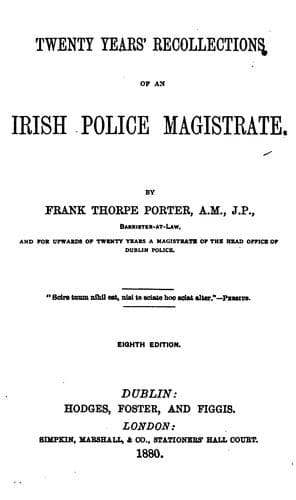
Twenty Years' Recollections of an Irish Police MagistratePorter, Frank Thorpe
History
Twenty Years' Recollections of an Irish Police Magistrate
Porter, Frank Thorpe
Crime -- Ireland; Criminals -- Ireland; Ireland -- Social life and customs; Porter, Frank Thorpe, 1801-1882
It is pleasing to observe decided improvements in institutions of
importance to the community. In the time of Major Sirr, the coarsest
language was addressed from the bench of the police courts, not only to
prisoners on serious charges, but to persons prosecuting or defending
summonses. If a magistrate of police were now to apply terms of abuse,
even to the most disreputable characters, he would most certainly be
severely censured, or perhaps dismissed. The personal characters of the
present magistrates of Dublin ensure the observance of the strictest
propriety in their courts. I may remark, also, that imprisonment cannot
now be inflicted in the reckless manner formerly adopted. On the day
when my magisterial functions commenced, I called for a list of the
existing committals to the Dublin prisons from the Head Office. I was
astonished to find that one man had been detained for the previous
fifteen years, another for thirteen, and a third for ten, in default of
sureties to keep the peace, and be of good behaviour. I ordered the
immediate discharge of those persons, and two of them expressed great
dissatisfaction at being thrown upon the world from which they had been
so long estranged. These committals were signed by Major Sirr. There is
no danger of persons being now sent to prison, and forgotten there; for
if such a committal were sent, through ignorance or inadvertence, the
Board of Superintendence would soon draw attention to the fact of a
prisoner's subsistence being charged on the public for an illegal or
unreasonable period. At the time when the committals to which I have
alluded came under my notice, I happened to meet with some reports from
a Governor of the Richmond Bridewell addressed to the magistrates of the
Head Police Office during the time when that prison was under their
exclusive control and supervision. In one of these documents, the writer
states the building to be in good repair, and perfectly adapted for the
safe custody of its inmates, and that every ward was in a clean and
wholesome condition. He proceeds to describe the good effects produced
by the use he made of a barber, who, for riotous and disorderly conduct,
had been committed for two months with hard labour. He had not put the
delinquent to stone-breaking or oakum picking, but employed him in
shaving and hair-cutting the other prisoners, the effect of which was to
improve their appearance, and to impart cleanly tendencies. He then
expresses his regret that the barber's term of imprisonment had elapsed,
and that the prisoners had become less cleanly-looking from remaining
unshaven and uncropt. He terminates the report by earnestly and most
respectfully suggesting to "their worships" to avail themselves of the
first opportunity that may offer for committing _another barber for the
longest term in their power_.
Public-domain text, read in full here on John Shaqi.
Reviews
Reviews
No reviews yet
Be the first to share your thoughts on this work.
Elsewhere in the archive
Join the Discussion
Join the discussion
Sign in to leave a comment or review.
Sign InorCreate an account