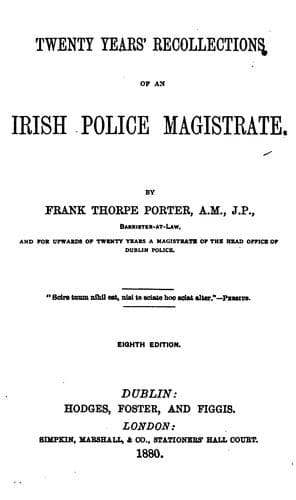
Twenty Years' Recollections of an Irish Police MagistratePorter, Frank Thorpe
History
Twenty Years' Recollections of an Irish Police Magistrate
Porter, Frank Thorpe
Crime -- Ireland; Criminals -- Ireland; Ireland -- Social life and customs; Porter, Frank Thorpe, 1801-1882
For some time after my appointment to the magistracy, Alderman John
Smith Fleming was my senior colleague at the Head Office. He had a very
vivid recollection of the rebellion of 1798, and was secretary to his
uncle, Alderman Thomas Fleming, Lord Mayor of Dublin in that year.
Amongst other anecdotes of that period, I have heard him relate that
Dwyer, one of the insurgent chiefs, had prolonged his resistance for
some months after the insurrection had been generally quelled. In the
mountains of Wicklow, with a few but faithful followers, he evaded every
exertion for his capture. Mr. Hume, of Humewood, near Baltinglass, was
particularly anxious to secure Dwyer. He was the commander of a corps of
yeomanry, and a magistrate of the County of Wicklow, which he also
represented in Parliament. Of very extensive influence, he easily
procured the co-operation of the civil and military authorities of his
own and of the adjoining districts. Still Dwyer was not to be had. At
length an arrangement was made that the yeomanry corps of the western
portion of Wicklow should assemble, at an early hour on an appointed
day, at Humewood, and should set out to scour the country, exploring
every recess, and leaving no place, on hill or plain, unransacked for
Dwyer. Yeomanry from Wexford, Carlow, and Kildare were to move on
preconcerted points, so as to intercept the fugitive if he should
attempt to shift his quarters. A day was wholly spent in a most
fatiguing search. It seemed as if Dwyer had transformed himself into a
bird, and flown beyond sight or reach. However, in a short time, Mr.
Hume received an intimation, that if Dwyer's life would be spared, and
that he would be permitted to leave the country, he was willing to
surrender. With the assent of the Government, Mr. Hume acceded to this
offer. Dwyer was brought to Dublin, and the required undertaking and
consequent immunity from punishment were acknowledged before the Lord
Mayor. The outlaw was kindly and generously treated by Mr. Hume during
the few days which preceded his departure for America; and at a final
interview Mr. Hume said--"Before we part, Dwyer, will you tell me how
you avoided capture on the day that we scoured the whole country in
search of you?" "Sir," replied Dwyer, "I had information of your
intentions, so I went to Humewood on the night before, and when the
yeomen were paraded on your lawn, before they started in search of me,
_I was looking at them from your hay-loft_."
Public-domain text, read in full here on John Shaqi.
Reviews
Reviews
No reviews yet
Be the first to share your thoughts on this work.
Elsewhere in the archive
Join the Discussion
Join the discussion
Sign in to leave a comment or review.
Sign InorCreate an account