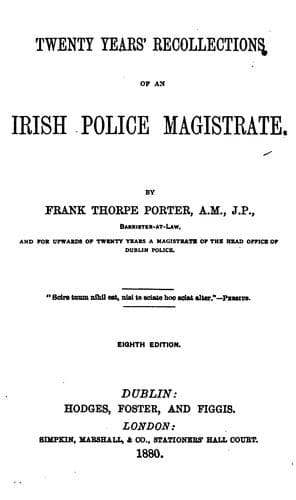
Twenty Years' Recollections of an Irish Police MagistratePorter, Frank Thorpe
History
Twenty Years' Recollections of an Irish Police Magistrate
Porter, Frank Thorpe
Crime -- Ireland; Criminals -- Ireland; Ireland -- Social life and customs; Porter, Frank Thorpe, 1801-1882
_post mortem_ examination, and thereby doubled the doctor's ordinary
fee. The coroner and his associate were convicted of conspiring to
defraud, and consequently were deprived of their functions. It must be
acknowledged that, if their mode of procuring inquests was not honest,
it was certainly novel and ingenious. If the practice had been known in
the days of Hamlet, it would have furnished an additional reason for his
exclamation:--
"To what base uses we may return, Horatio."
In the year 1842, and for several subsequent years, by an arrangement
with my colleagues, I undertook the magisterial duties connected with
the licensing and regulation of job and hackney vehicles, and the
adjudication of complaints in the carriage court. At the time when I
assumed those duties, Richard Wilson Greene (whose high legal
acquirements ultimately obtained for him the position of Baron in the
Court of Exchequer) was in very extensive practice at the Bar. An issue
from Chancery was sent to be tried at one of the principal towns on the
Leinster Circuit, and he was specially retained for one of the parties.
A very efficient reporter, named Christopher Hughes, in whose character
there was great comical eccentricity, was employed to take down, in
shorthand, the trial of the issue. Early in the succeeding term, it was
arranged that a consultation should be held at the house of the senior
counsel, in Leeson Street, and Mr. Hughes was requested to meet Mr.
Greene at the Courts, with his notes, and to accompany him to the
consultation. The appointed time had nearly arrived, when Greene and
Hughes hurried off from the Four Courts. Having passed out to the quay,
the former hailed an outside car, on which they sat beside each other,
and the driver was ordered to make all possible haste to Leeson Street.
The horse was a fine-looking animal, but he stepped high and was very
slow. Mr. Greene urged the driver to hasten on, and after two or three
expostulations, he remarked to the Jehu that the horse was unfit for a
jaunting car, although he was large and strong, but that he would suit
well for a family carriage. The driver, a lad of eighteen or nineteen
years of age, exclaimed, "Bedad your honor is a witch!" "What do you
mean?" asked Mr. Greene. "Oh," replied the carman, "I mane no offince,
but yer honor is right about the baste; that's what he is. I'll tell yer
honor a saycret. The baste is a carriage horse belonging to one
Counsellor Greene, and the coachman has a hack-car and figure on Bride
Street stand. He ginerally manages to have something the matther with
one of the horses, and that gives him an opportunity to get a good deal
of work out of the other in the car." Although Mr. Greene was very angry
at what the driver had communicated, he did not disclose that he was the
owner of the horse. He whispered to Hughes, and requested him to give
the driver his name and address, but to leave him unpaid. When they
Public-domain text, read in full here on John Shaqi.
Reviews
Reviews
No reviews yet
Be the first to share your thoughts on this work.
Elsewhere in the archive
Join the Discussion
Join the discussion
Sign in to leave a comment or review.
Sign InorCreate an account