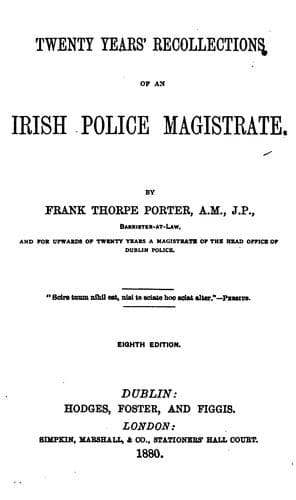
Twenty Years' Recollections of an Irish Police MagistratePorter, Frank Thorpe
History
Twenty Years' Recollections of an Irish Police Magistrate
Porter, Frank Thorpe
Crime -- Ireland; Criminals -- Ireland; Ireland -- Social life and customs; Porter, Frank Thorpe, 1801-1882
For some years previous to 1842, the number of persons "found drowned"
in the County of Dublin was much greater than might be expected either
from the extent of the population or the nature of the locality. It was
indeed true that one canal, the Grand, extended along the greater part
of the southern boundary of the Irish metropolis, and another, the
Royal, was similarly situated in the northern direction; but although
these canals afforded great facilities for the termination of human
existence, whether by suicide or accident, the cases of drowning were
far more numerous than could be fairly attributed to violence,
intoxication, lunacy, or carelessness. It would also seem that the
southern canal was much more destructive to human life than the other,
and that the bank which was in the county possessed some attraction for
the corpses, for they were almost always taken out at the county side.
It happened on the 11th of March, 1842, a few minutes before 10 o'clock,
a.m., that a young man named Kinsella, who was employed in a distillery
at Marrowbone Lane, was proceeding, after his breakfast, from his
residence at Dolphin's Barn to resume his work, when, on approaching the
canal bridge, he was stopped by a constable, who informed him that the
coroner required his attendance, as a juror, on an inquest that was
about to be held on the body of an old man, just taken out of the canal.
Kinsella vainly expostulated against the detention. He was told that it
would be a very short business, for there were no marks of violence on
the corpse; it would merely be a case of "found drowned." The man was
accordingly sworn on the inquest, and the coroner having informed the
jury that they were required by law to view the body, they were
conducted to the apartment where it lay. As soon as Kinsella beheld the
corpse, he rushed forward, dropped on his knees beside it, seized the
stiff and frigid hand, and exclaimed, "My father! my poor, dear father!
We buried him on this day week, decently and well, in the Hospital
Fields. He had no business in the canal; and _them old clothes_ never
belonged to him; he never wore a stitch of them." The coroner and the
doctor vainly endeavoured to persuade Kinsella that he was mistaken; and
his recognition of his parent produced an enquiry, which resulted in
bringing to light some very extraordinary practices on the part of the
county functionary and his medical satellite. They were paid by public
presentment, according to the number of inquests held; and they had
recourse to the expedient of having bodies disinterred, clothed in old
habiliments, and thrown into the canal. Such bodies were almost always
discovered very soon, and were taken out on the county side of the
canal, to swell the coroner's next presentment for inquests on persons
who were "found drowned." A crush from a passing barge afforded an
additional profit, as the bruises constituted a plausible reason for a
Public-domain text, read in full here on John Shaqi.
Reviews
Reviews
No reviews yet
Be the first to share your thoughts on this work.
Elsewhere in the archive
Join the Discussion
Join the discussion
Sign in to leave a comment or review.
Sign InorCreate an account