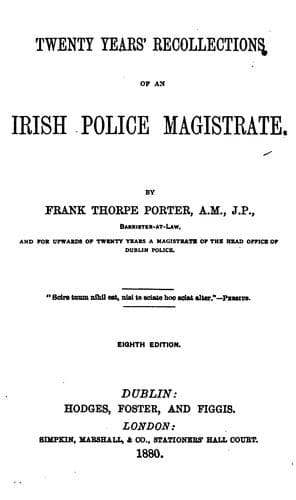
Twenty Years' Recollections of an Irish Police MagistratePorter, Frank Thorpe
History
Twenty Years' Recollections of an Irish Police Magistrate
Porter, Frank Thorpe
Crime -- Ireland; Criminals -- Ireland; Ireland -- Social life and customs; Porter, Frank Thorpe, 1801-1882
visitor various exclamations of delight and surprise. I sent off my
report, and it appeared in due time, but unfortunately the king was too
much hurried by other arrangements, and did not go to the Waterfall at
all, but drove direct from Powerscourt House to Kingstown, where he
embarked. I have been often quizzed for my imaginative report, but,
nevertheless, I stated what the King _ought_ to have done, and what he
_ought_ to have said, and if he did otherwise, it was not my fault."
I was extremely fortunate, at my accession to magisterial office, to
find myself provided with clerks who could not be surpassed in
diligence, integrity, or intelligence. I shall particularize Messrs.
Pemberton and Cox. The former was the son of a previous chief
magistrate, at whose instance he was appointed. The latter had been for
several years in America, and had been engaged by Jacob Philip Astor in
forming the settlement of Astoria, in Washington Irvine's description of
which he is most favorably mentioned. He was a man of great literary
taste, and was an accomplished linguist. Their performance of official
duties never required from me, nor to my knowledge from any of my
colleagues, the slightest correction or reproof. Pemberton was a
solicitor, and was promoted in 1846 to the Clerkship of the Crown for
the King's County. He had been many years before an assistant to Messrs.
Allen and Greene, the Clerks of the Peace for the City of Dublin. I
shall have to notice hereafter some amusing incidents connected with
Cox, but shall give precedence to a few anecdotes derived from
Pemberton, and arising from his acquaintance with the old Session House
in Green Street, and the records there, to which, I suppose, he had full
access.
Towards the close of the last century an aid-de-camp of the then viceroy
was indicted, at the Quarter Sessions, for the larceny of a handsome
walking-stick, and also for assaulting the gentleman who owned it, and
who was, moreover, a Frenchman. The transaction arose in a house of a
description unnecessary to be particularized. An affray took place, the
Frenchman was kicked down stairs, and lost his cane, which was alleged
to have been wrested from him by the aid-de-camp. The charge of larceny
was absurd, and the grand jury ignored the indictment. But the assault
could neither be denied nor justified, and the traverser submitted,
pleaded "guilty," and was fined five pounds. That punishment did not
cure his propensity for beating Frenchmen and taking their _sticks_. On
the 21st of June, 1813, he beat Marshal Jourdan at Vittoria, and
captured his _baton_; and on the 18th of June, 1815, at Waterloo, he
beat the greatest Frenchman that ever lived, Napoleon Bonaparte. I do
not feel justified in naming the delinquent aid-de-camp, and perhaps the
reader may think it quite unnecessary that I should.
Public-domain text, read in full here on John Shaqi.
Reviews
Reviews
No reviews yet
Be the first to share your thoughts on this work.
Elsewhere in the archive
Join the Discussion
Join the discussion
Sign in to leave a comment or review.
Sign InorCreate an account